
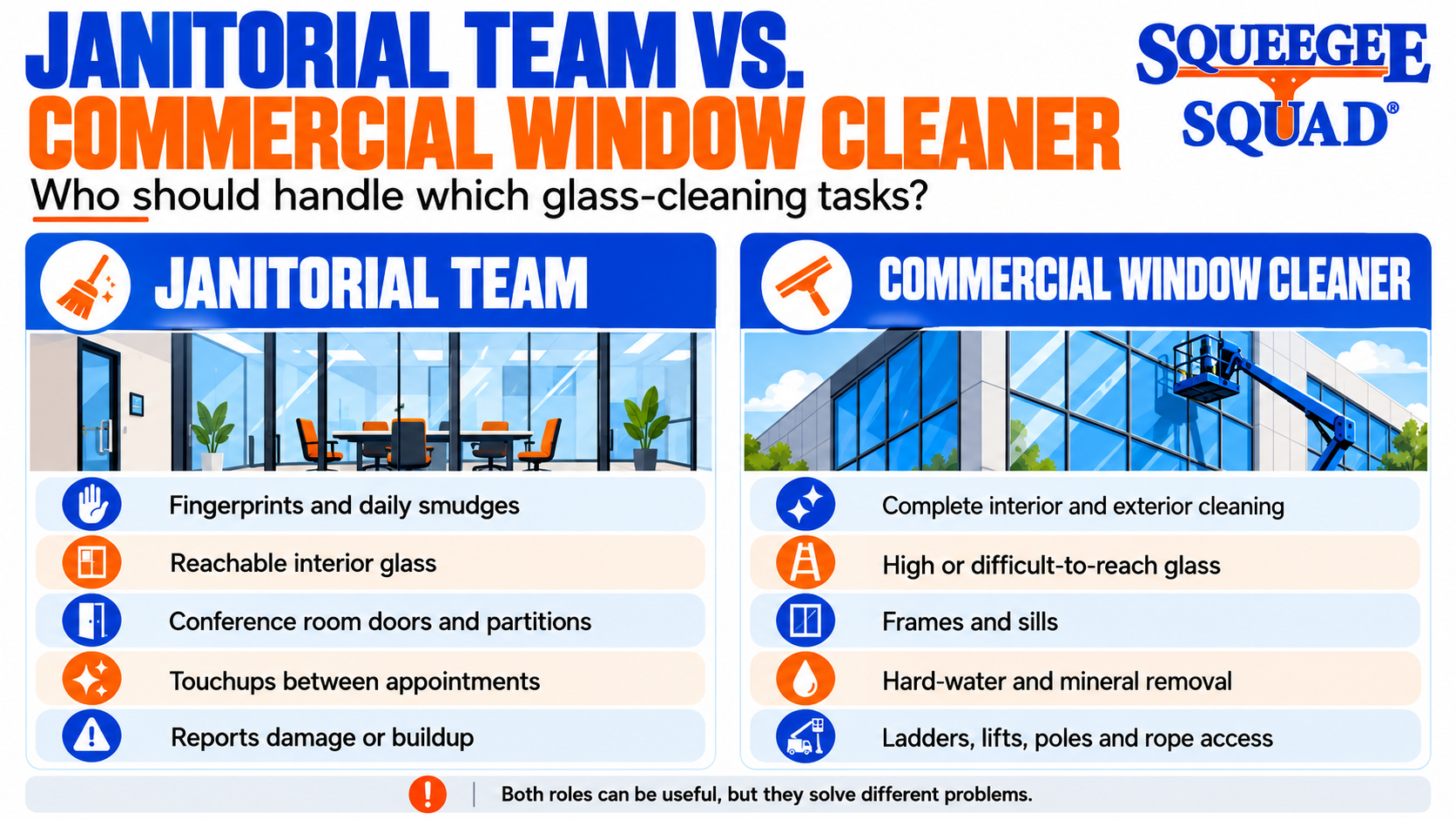
A janitorial team can handle fingerprints and routine touch-ups on interior glass it can reach safely. Exterior windows, high glass, full window cleaning and mineral removal should be handled by a commercial window-cleaning company.
That division gives the janitorial team a reasonable daily scope while making sure the windows receive the tools, training and attention they need.
Melissa Brinkley, CEO of Squeegee Squad Tulsa, said most janitorial contracts cover reachable interior glass. That may include entry doors, conference room glass, partitions and other surfaces that collect fingerprints during the day.
Once the work moves outside, above normal reach or beyond a basic wipe-down, it usually falls outside the janitorial team’s scope.
What janitorial window cleaning usually includes
Janitorial cleaning is built around the routine needs of a building. The crew may empty trash, clean restrooms, vacuum floors and wipe down frequently touched surfaces after employees and visitors leave.
Interior glass can fit naturally into that routine. A janitor may clean fingerprints from a conference room door, wipe smudges from a partition or touch up the inside of an entrance.
This works well when the glass:
- Is indoors
- Can be reached from the floor
- Needs frequent touch-ups
- Does not have mineral deposits or other buildup
- Does not require specialized access or equipment
The exact scope depends on the janitorial contract and the company’s insurance. Property managers should not assume that ladders, exterior glass or high interior windows are included simply because the contract mentions “window cleaning.”
Ask what the company means by that phrase and where its work stops.
When should you hire a commercial window cleaner?
Bring in a commercial window-cleaning company for exterior windows, high interior glass and complete periodic cleaning.
Melissa uses about six feet as a practical dividing line. Above that point, a worker may need an extension pole, ladder, lift or another access method. The work introduces hazards and equipment that may not be covered by a janitorial company’s training or insurance.
A specialist is also the better choice when the windows have:
- Hard-water deposits
- Sprinkler stains
- Construction debris
- Oxidation or buildup around the frames
- Film, coatings or other specialty surfaces
- Glass above entrances or pedestrian areas
- Access that requires ladders, lifts or rope descent systems
Exterior glass also shapes the first impression of the property. Customers and employees see it before they see the freshly vacuumed lobby or clean break room.
Janitorial touch-ups and professional window cleaning produce different results
A janitorial worker may use glass cleaner and a towel to remove fingerprints from the section of glass within reach. That is useful maintenance, but it is easy to see where the cleaning stopped. The upper portion may remain hazy, and residue can build up along the edges.
Professional window cleaners use squeegees, extension poles, water-fed systems and other equipment selected for the glass and its location. They are trained to control the cleaning solution, choose appropriate tools and reach the entire pane.
The service may also include the frames and sills. Clean glass surrounded by bird droppings, oxidation or dirty framing still makes the building look neglected.
A complete scope should state whether the company will clean:
- Interior glass
- Exterior glass
- Entry doors
- Interior partitions
- Frames and sills
- High or difficult-to-reach windows
- Glass affected by mineral deposits
Clear scopes keep the property manager, janitorial company and window cleaner from assuming someone else is responsible.
Commercial window cleaners are trained for access and public safety
Window cleaning changes when the crew leaves the ground. Ladders, water-fed poles, lifts and rope systems all require training beyond general building cleaning.
The crew must also account for the people moving around the work area.
When technicians are working above ground, the area below may become a drop zone. It has to be marked and physically separated from pedestrian traffic. Ground-level work may also require barricades when ladders, poles or hoses affect a walkway.
Doors need special attention. A person walking through an entrance or driving out of a garage is unlikely to expect a ladder or tool on the other side. The safest option may be to close that entrance briefly while the crew works in the immediate area.
Squeegee Squad evaluates those conditions before the crew begins. The access plan may account for building height, landscaping, entrances, vehicle traffic and the space required to use equipment safely.
A janitorial worker assigned to wipe down interior glass is unlikely to have the equipment or site plan needed for that work.
The wrong tool can damage modern commercial glass
Glass does not always reveal what has been applied to it. A window may have film, a low-emissivity coating, an aftermarket security coating or another surface that requires specific care.
Even a squeegee can cause damage if its metal edge contacts a vulnerable coating. Scrapers and abrasive pads create additional risk when the cleaner does not know how the glass was manufactured or treated.
Property managers should tell the window-cleaning company about:
- Window film or tint
- Security or impact-resistant coatings
- Smart glass
- Manufacturer cleaning requirements
- Recently installed or replaced windows
- Known scratches, seal problems or damaged panes
With that information, the company can review the manufacturer’s maintenance instructions and choose a method that will not interfere with the product warranty.
Mineral deposits require more than routine cleaning
Sprinklers are a common source of hard-water staining on commercial windows. The water dries on the glass and leaves minerals behind. On southern and western exposures, heat from the sun can make the deposits increasingly difficult to remove.
Maintenance cleaning will not always remove that buildup. The window may need a separate restoration service with different products, tools and labor.
Melissa said Squeegee Squad Tulsa can often restore mineral-covered glass for 10 percent or less of what replacement would cost. The actual price depends on the condition of the window, but restoration is worth investigating before ordering new glass.
Cloudiness between the panes is different. Moisture, dust or insects inside a sealed glass unit can indicate that the seal has failed. Cleaning cannot reach the space between the panes or restore the window’s insulating performance. That glass may need to be evaluated for replacement.
A window cleaner can help determine whether the problem is surface buildup or something inside the glass.
Janitorial companies and window cleaners can work together
The two services do not need to overlap.
A practical arrangement may look like this:
| Janitorial team | Commercial window cleaner |
|---|---|
| Daily fingerprints and smudges | Complete interior and exterior cleaning |
| Reachable interior doors and partitions | High interior glass |
| Routine spot cleaning | Frames and sills |
| Touchups between appointments | Mineral removal and restoration |
| Reporting new buildup or damage | Ladders, lifts, water-fed poles and rope access |
Some janitorial companies include exterior window cleaning in a master service agreement and hire a window cleaner as a subcontractor. This gives the property manager one vendor to manage.
Working directly with the window-cleaning company may cost less because the price does not have to account for another company’s administration, billing and payment delay. The right arrangement depends on the property’s purchasing requirements and how much vendor management the facility team wants to handle.
Either way, the scope should identify who is responsible for each type of glass.
What to compare when reviewing proposals
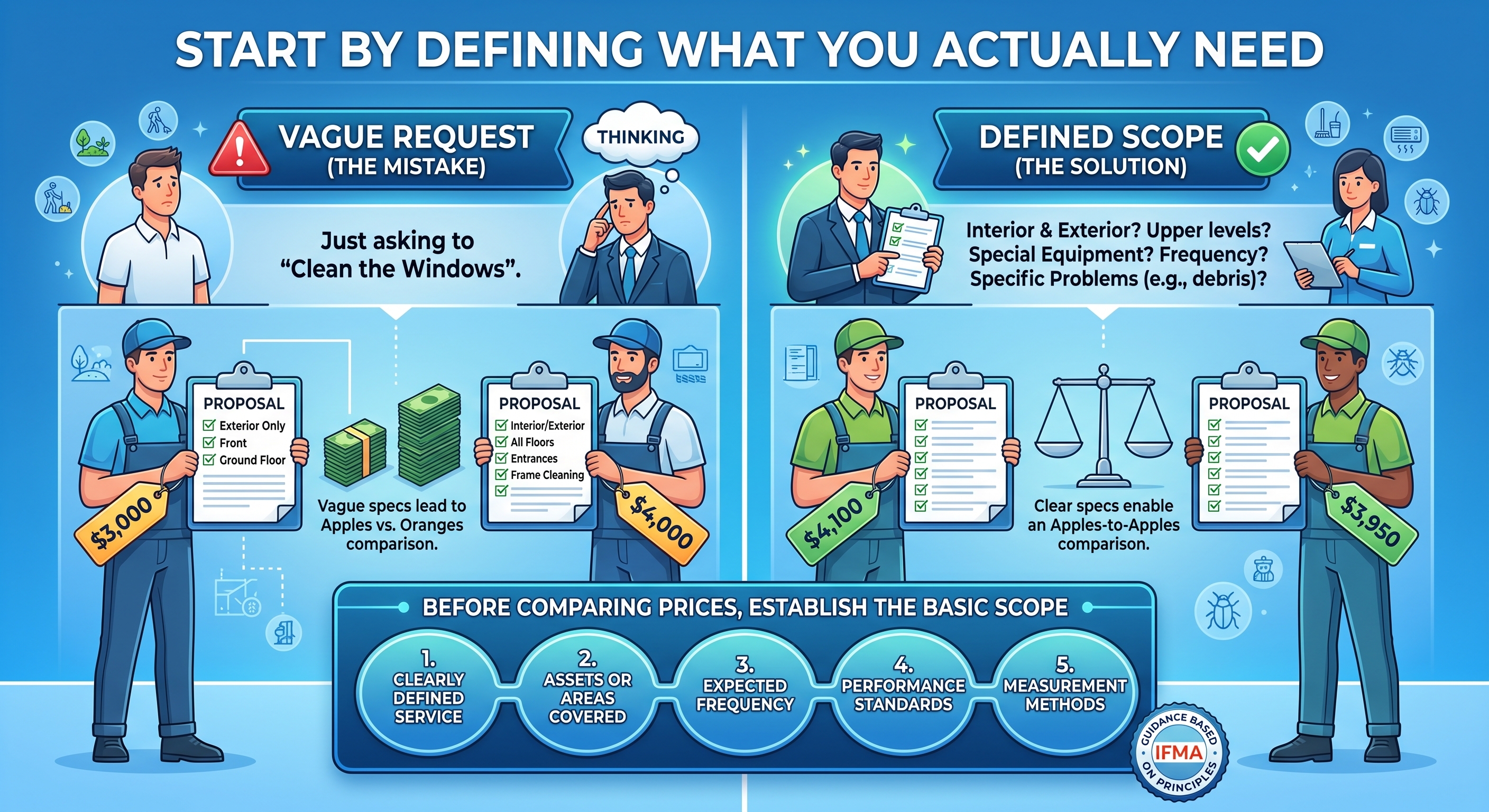
Price per visit does not tell you whether two companies are offering the same service.
Before comparing totals, check whether each proposal includes:
- Interior, exterior or both
- Frames and sills
- Entry doors and partitions
- High glass
- Hard-water or mineral removal
- Specialty glass procedures
- Equipment required for access
- Barricades and pedestrian controls
- Recurring service frequency
- Proof of insurance
- Reporting for skipped, damaged or inaccessible glass
Ask how the company will clean the property, where its standard service ends and which conditions would require a separate estimate.
A lower price loses its value if half the glass is outside the quoted scope.
Questions to ask before assigning window cleaning
Ask the janitorial company:
- Which interior windows are included in our contract?
- What is the maximum height your employees may clean?
- Are employees permitted and insured to use ladders or step stools?
- Does the contract include any exterior glass?
- Who reports mineral buildup, damaged glass or areas outside the scope?
Ask the commercial window-cleaning company:
- How will you reach our exterior and high interior windows?
- Are frames and sills included?
- How do you protect pedestrians near the work area?
- Can you identify and treat hard-water deposits?
- What information do you need about films or specialty coatings?
- Can you provide a current certificate of insurance?
- What work would require a separate restoration estimate?
The answers should give the facility manager a clear division of responsibility before service begins.
Frequently asked questions
Can janitorial staff clean commercial windows?
Yes. Janitorial staff can handle reachable interior glass and routine fingerprint removal when that work is included in the contract.
Should a janitorial company clean exterior windows?
Usually, exterior window cleaning is assigned to a commercial window-cleaning company with the equipment, training and insurance required for exterior access.
Who should clean high interior windows?
A commercial window cleaner should handle glass that requires extension poles, ladders, lifts or other specialized access.
Is hard-water removal included in regular window cleaning?
Usually not. Mineral removal is a restorative process that takes more time than maintenance cleaning and may require a separate estimate.
Can a window cleaner remove cloudiness between two panes of glass?
No. Moisture or debris between sealed panes may indicate seal failure. Cleaning can address deposits on the exposed surfaces, but it cannot reach inside the glass unit.
Can a janitorial company subcontract professional window cleaning?
Yes. Some janitorial companies include exterior glass in a broader service agreement and hire a window-cleaning specialist to perform that portion of the work.
Give each company a clear scope
Your janitorial team can keep reachable interior glass presentable between appointments. A commercial window cleaner can take responsibility for the exterior, high glass, complete cleaning and conditions that require specialized treatment.
Squeegee Squad Tulsa works directly with facility managers and also partners with janitorial companies when window cleaning is included in a larger service agreement. Contact us to evaluate the glass, define the scope and build a recurring schedule for your property.
Topics: