 By
By

Key Points
- Only a licensed insurance company, broker or authorized agent can legally create and issue a Certificate of Insurance (COI).
- A 2025 Underinsurance in Small Business Report found that 77% of small businesses are incorrectly or underinsured.
- Accepting an invalid certificate of insurance could cost your company millions.
Most property managers request certificates of insurance directly from their contractors.
Imagine this scenario:
- Accounting calls the property manager and says, “I have an invoice here from Shady Painters LLC, but I can’t pay it until I have a current certificate of insurance on file.”
- The property manager contacts Shady Painters LLC and says they need a current certificate of insurance.
- Shady Painters LLC provides a professional-looking certificate of insurance.
- The invoice gets paid. All is well in the world for the moment, until your tenants are screaming about paint peeling off the walls and Shady Painters LLC won’t return any of your calls.
After 15 years cleaning commercial windows across Northeastern Oklahoma, we’ve identified ways shady contractors get around this requirement, get paid, then disappear when problems arise. This article breaks down what property managers should know about certificates of insurance, what a certificate of insurance does not guarantee and the absolute easiest way to avoid getting scammed.
What Should Property Managers Know About Certificates of Insurance (COI)?
A Certificate of Insurance is a one-page summary that provides proof of a contractor’s active coverage.
A Certificate of Insurance (COI) normally includes the contractor’s legal name and address, the insurer, types of coverage, policy limits, effective dates and certificate holder information. It ensures that if a contractor damages property or causes an injury, the contractor’s insurance will cover the costs rather than passing the liability on to your business. For a quick read on Certificates of Insurance, visit Travelers article What Is a Certificate of Insurance?
I’ve found, however, that it’s not so much about what’s included on a Certificate of Insurance that matters. It’s what’s not included that tends to get contractors and property managers in trouble.
What a Certificate of Insurance Fails To Describe?
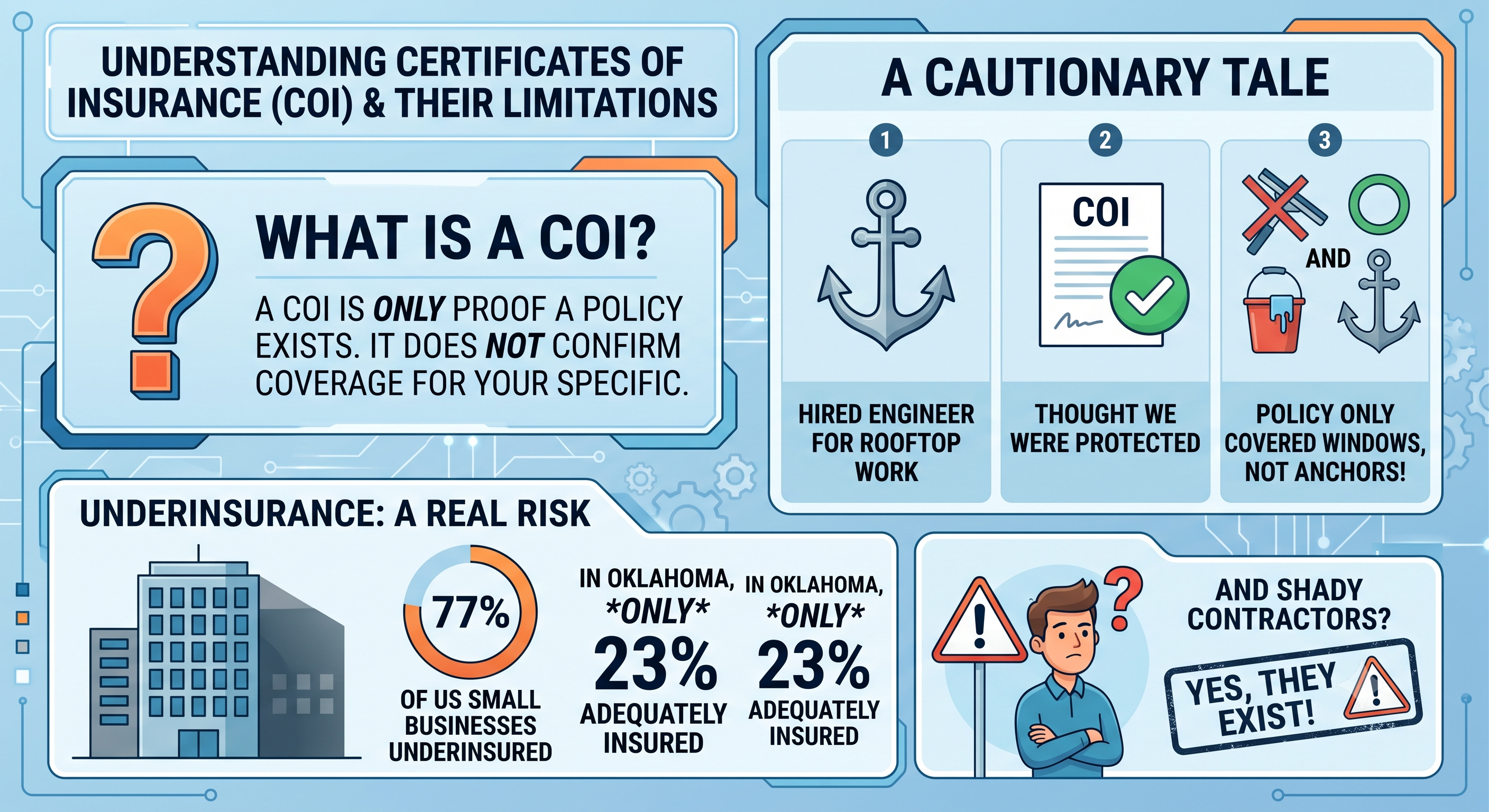
A Certificate of Insurance does not confirm that a contractor is insured to perform the work you hired them to perform. The certificate simply confirms the existence of a policy.
Let’s use an example that happened to my company. Fortunately, this story has a happy ending.
In 2025, we subcontracted the engineering portion of a rooftop anchor inspection to a trusted engineering and testing firm based in Illinois. We billed the customer for the work. They requested a certificate of insurance, which we promptly requested from our insurance broker.
As part of our internal processes, we had already obtained a certificate of insurance from the engineering and testing firm. We thought we did everything correctly.
However, our broker informed us that we had exposed ourselves to unnecessary risk by invoicing for a service our policy didn’t cover. Our policy covered window cleaning, not anchor inspections. Since the invoice had our name on it, our broker informed us that we inadvertently transferred the risk onto ourselves.
Had any damage occurred to the property or persons on the property when the work was being performed, we may not have been covered.
Fortunately no damage occurred, but a lesson was learned.
Even well-intentioned contractors find themselves underinsured. In fact, according to The 2025 Hiscox Underinsurance in Small Business Report, 77% of small businesses in the US are incorrectly or underinsured. In May of 2026, Boostsuite shared that there are 358,647 small businesses in Oklahoma.
Hiscox’s study indicates that 276,158 of the 358,647 small businesses in the state of Oklahoma could be incorrectly or underinsured.
What about those ill-intended (i.e. shady) contractors? Are they out there?
You bet they are!
Can a Contractor Forge a Certificate of Insurance?
Contractor forgery of certificates of insurance happens more often than you think.
In Alabama, Dreamway Construction, LLCwas caught forging a certificate of insurance, and the owner faces prison time and a hefty fine. In California, plumbing contractor Adan Deniz was arraigned on 21 felony counts of forgery after allegedly creating fraudulent certificates of insurance. And most recently, in December 2025, Christian Riggi, a contractor in New York “was allegedly operating a business off-the-books and in the dark, using fake insurance documents and other certificates to build credibility and obtain licenses for a company that had not legally existed for nearly a decade.”
I get it, contractors need work. But there’s a right way and a wrong way to earn the work.
Forging certificates of insurance is definitely the wrong way.
But how do property managers know if the contractor they are hiring is properly insured?
There’s an easy way to find out!
What Property Managers Can Do Right Now (And It Only Takes 30 Seconds)
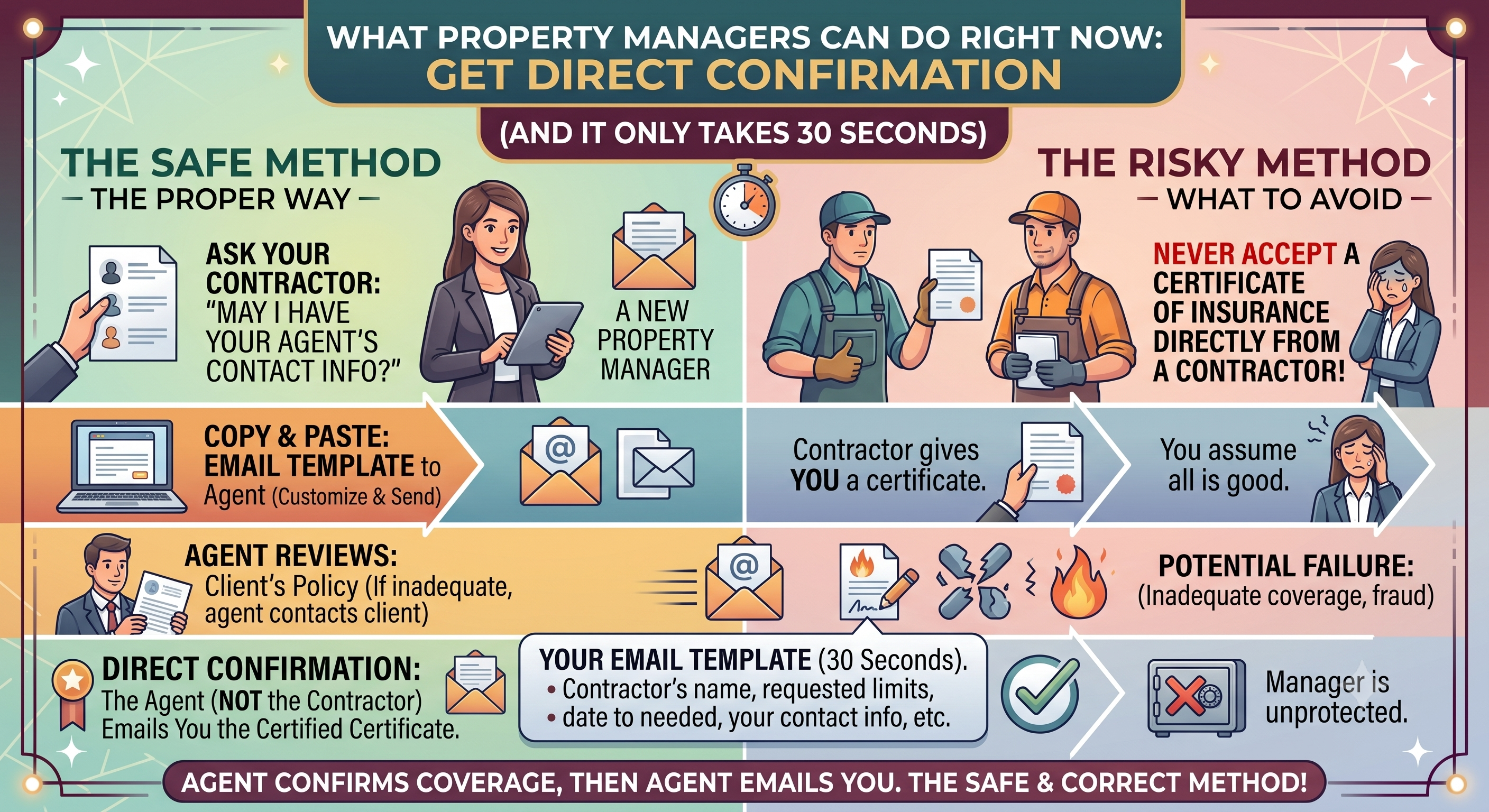
Never accept a certificate of insurance from a contractor.
Any trustworthy contractor should be happy to provide you with his/her insurance agent’s contact information. Once you obtain the agent’s email address, simply copy/paste the email template below into the body of your email, customize it and hit send. The contractor’s agent will review their client’s policy and will reach out to them directly if they don’t have adequate coverage. Once the correct coverage is confirmed, the agent (not the contractor) will email you the certificate of insurance.
Fill out this email template and send it to your contractor’s insurance agent.
Email Template:
Subject: Certificate of Insurance Request – [Contractor Name] – [Project Name/Address]
Dear [Agent Name],
My name is [Your Name], and I am the [owner/authorized representative] of [Your Company Name]. We are in the process of hiring [Contractor Company Name] to perform the following work:
Scope of Work: [Brief description e.g., "Installation of exterior window cleaning access equipment," "Roof repair and gutter replacement," "Electrical rewiring of the second floor," etc.]
Location: [Job site address]
Estimated Dates: [Start date] through [End date]
Before finalizing our agreement, we want to confirm that [Contractor Company Name] carries insurance coverage adequate for the scope of work described above. Specifically, we'd appreciate confirmation of the following:
- General Liability – current limits (per occurrence and aggregate), and confirmation that the policy covers the type of work described above
- Workers' Compensation – confirmation of active coverage for all employees or subcontractors who will be on site
- Auto Liability (if applicable to this job)
- Umbrella/Excess Liability – limits, if applicable
- Additional Insured status – we would like [Your Company Name] added as an additional insured on the general liability policy for the duration of this project, if appropriate for the scope of work.
Could you please send a Certificate of Insurance (COI) reflecting the above, along with confirmation that current coverage is adequate for the described scope of work? If there are any exclusions or limitations relevant to this type of project, please flag those as well.
Please let me know if you need any additional details about the project to complete this request. You can reach me at [phone number] or [email address].
Thank you for your help.
Best regards,
[Your Name]
[Your Title]
[Your Company Name]
[Phone Number]
[Email Address]
Our Take on Fake Certificates of Insurance
My company could have claimed no wrongdoing, but that would be a lie. If you took the time to read this article, you learned that in 2025 we mistakenly provided a service we weren’t insured for. Once we learned of our error, we quickly corrected it.
Most contractors don’t intentionally falsify certificates of insurance. Contractors are, by nature, opportunistic and don’t know what they don’t know.
Shady contractors should be held accountable for their actions. However, property managers shouldn’t jump to conclusions the first time a contractor’s integrity is challenged. My article suggests practical ways property managers can address suspected fraud or forgery of certificates of insurance in a professional manner. If a contractor responds unprofessionally, then proceed to report the suspected fraud.
The question isn’t about whether you can spot a fake certificate of insurance. It’s about how property managers and contractors can work together to ensure that properties in Tulsa are maintained to the highest quality and highest insurance standards available.
If you are a Tulsa-area property manager whose looking for a window cleaner that prioritizes high quality workmanship and high insurance standards, we’d love to talk to you today!
How to Take Action Now
- Review all of your contractors’ certificates of insurance.
- Identify the contractors that appear to be out of compliance.
- Use the template provided in this article to contact non-compliant contractor insurance brokers.
- Don’t assume all contractors are shady.
Frequently Asked Questions
Should I always request additional insured status?
Yes, but expect to pay for it. Being “additional insured” means your company is legally added to the contractor’s insurance policy. You are essentially asking your contractor to share coverage with you. It’s not free, so don’t be surprised if a contractor requests that you share in the cost of adding you to their policy. For example, if a property management company wants to be listed as additional insured on my company’s policy, I charge $250-$500 per entity. This covers the incremental cost that my insurance company bills me to add an entity to my policy along with an administrative fee. Most hiring companies are happy to share in this cost if it means they are protected against lawsuits or claims related to that contractor’s work.
How do I know if a certificate of insurance is fake?
You don’t know. A certificate is highly unlikely to be fake if it comes directly from the contractor’s insurance agent. I provide a simple email template in this article that makes it easy.
What do I do if I find out my contractor submitted a fake or forged certificate of insurance?
- If the contractor is on your property, stop all work immediately.
- Demand a legitimate COI sent from the insurance broker/agent.
- Withhold payment until valid proof of insurance is provided.
- Terminate the contract if necessary.
- Report the contractor to the Oklahoma Insurance Department and the National Insurance Crime Bureau.
How do I hire reputable contractors?
- Read their Google Reviews, especially the one and two star reviews.
- Ask other property managers if the contractor is reputable.
- Ask for references, then call them.
About the Author:
Melissa is the CEO of Aye-Yah LLC DBA Squeegee Squad, a commercial window cleaning business serving to greater Tulsa area Squeegee Squad believes that predicable excellence means always delivering high quality results that are backed by high insurance standards.