
 By
By
Key Takeaways
- Visible dirt is not necessarily the best indicator that commercial glass needs attention. Environmental contaminants can accumulate before the condition becomes obvious from a distance.
- The International Window Cleaning Association recommends establishing maintenance intervals before severe surface soiling develops. The appropriate interval can vary substantially from one property to another.
- Location matters. Pollen, rainfall, sprinklers, construction activity, traffic, landscaping, and surrounding environmental conditions can all influence how quickly exterior glass becomes contaminated.
- Tulsa's seasonal environment makes calendar-based planning especially relevant. Tree pollen, grass pollen, weed pollen, rainfall, wind, and other changing conditions mean a building's exposure is not constant throughout the year.
- The goal of a maintenance program should not simply be to respond to dirty glass. It should be to prevent routine contamination from becoming a more difficult maintenance problem.
Most decisions about window cleaning begin with a visual inspection.
The windows look clean, so nothing needs to be done.
Eventually, dirt, streaks, spots, or a visible film begin to appear. At that point, someone notices the glass and schedules a cleaning.
It seems like a perfectly reasonable maintenance strategy.
The problem is that visible dirt is a lagging indicator.
By the time contamination becomes noticeable from the parking lot, the glass may have already been exposed to weeks or months of airborne particles, pollen, minerals, sprinkler water, construction debris, runoff, and other environmental contaminants.
Research and guidance published by organizations involved with architectural glass maintenance suggest that a more effective approach is to think about window cleaning as preventive building maintenance rather than a reaction to appearance alone.
The question for a property manager therefore shouldn't always be:
“Do the windows look dirty?”
A better question may be:
“What has this glass been exposed to since it was last cleaned?”
The Problem With Waiting Until Glass Looks Dirty
There is an important difference between appearance and condition.
A property manager standing 50 or 100 feet away from a building is evaluating the appearance of the glass.
A technician working directly against that glass is evaluating its condition.
Those two observations can be very different.
Fine particulate matter, pollen, mineral deposits, water spots, and other contaminants don't necessarily become dramatically visible immediately after reaching the glass. They accumulate.
The International Window Cleaning Association's research into architectural glass maintenance makes an important distinction between routine cleaning and more complicated forms of stain removal and restoration.
Its Glass Surface Maintenance Matrix describes routine cleaning as methods designed primarily to remove water-soluble dirt and debris using relatively mild processes. As conditions become more severe, different products, procedures, and restoration techniques may be required.
That distinction is important.
Waiting longer doesn't simply create “more dirt.” In some circumstances, it can change the type of cleaning problem you're dealing with.
Glass Maintenance Is More Preventive Than Most People Realize
One of the most useful pieces of research on this subject comes from an International Window Cleaning Association publication addressing the cleaning and restoration of architectural glass.
The publication examines several examples of significant glass contamination, including particulate buildup, concrete runoff, and hard-water spotting.
Its conclusion is particularly relevant for property managers: those conditions represent situations where the glass should have received cleaning and maintenance before the contamination became that severe.
Read the IWCA publication on architectural glass cleaning and restoration.
The same publication explains that the frequency of exterior glass cleaning can vary based on the property's specific environment.
That changes the way we should think about the phrase “clean windows.”
A window can still appear acceptable while moving toward a condition that will eventually require more effort to correct.
In other words, the ideal time to clean the glass may occasionally occur before the building looks like it needs window cleaning.
There Is No Universal Window Cleaning Schedule
This creates another problem.
If waiting until the windows look dirty isn't always ideal, should every commercial property simply clean its windows every month?
No.
That would ignore the same environmental variables we're trying to account for.
A downtown storefront facing a heavily traveled street doesn't experience the same conditions as an office building surrounded by landscaping.
A medical facility doesn't necessarily experience the same conditions as a warehouse.
Two sides of the same building can even accumulate contamination at different rates.
The IWCA's research notes that reasonable intervals between exterior glass cleanings depend on the specific environment surrounding the property, and that site evaluations can help determine an appropriate maintenance schedule.
The IWCA provides additional resources on routine architectural glass cleaning here.
This is why we don't believe a property manager should be handed a universal answer like:
“Every building needs its windows cleaned twice a year.”
That's simple.
It just isn't very informative.
A better maintenance schedule considers what is actually happening around the building.
Tulsa's Environment Makes This Particularly Interesting
Oklahoma gives us a good example of why environmental exposure should be part of the conversation.
Tulsa doesn't experience one consistent environmental condition throughout the year.
The Tulsa Health Department identifies several distinct pollen periods in Tulsa County:
- Spring brings tree pollen.
- Summer brings grass pollen.
- Late summer and fall bring weed pollen, particularly ragweed.
The Tulsa Health Department explains Tulsa County's seasonal pollen patterns here.
From a window-cleaning perspective, the important takeaway isn't the allergy symptoms.
It's the fact that the amount and type of airborne biological material surrounding a Tulsa property changes throughout the year.
And pollen isn't the only environmental variable.
Tulsa also experiences substantial seasonal rainfall.
The National Weather Service maintains more than a century of spring rainfall records for Tulsa, with significant variation between individual years.
You can view the National Weather Service's historical spring rainfall data for Tulsa here.
Rain itself doesn't automatically mean windows need to be cleaned.
But rainfall can interact with dust, pollen, building runoff, landscaping, and existing surface contamination.
That's why the calendar matters.
Your building isn't exposed to the same environment in April that it is in January.
The Building's Surroundings Matter Just as Much as the Weather
Weather receives a lot of attention because it's easy to recognize.
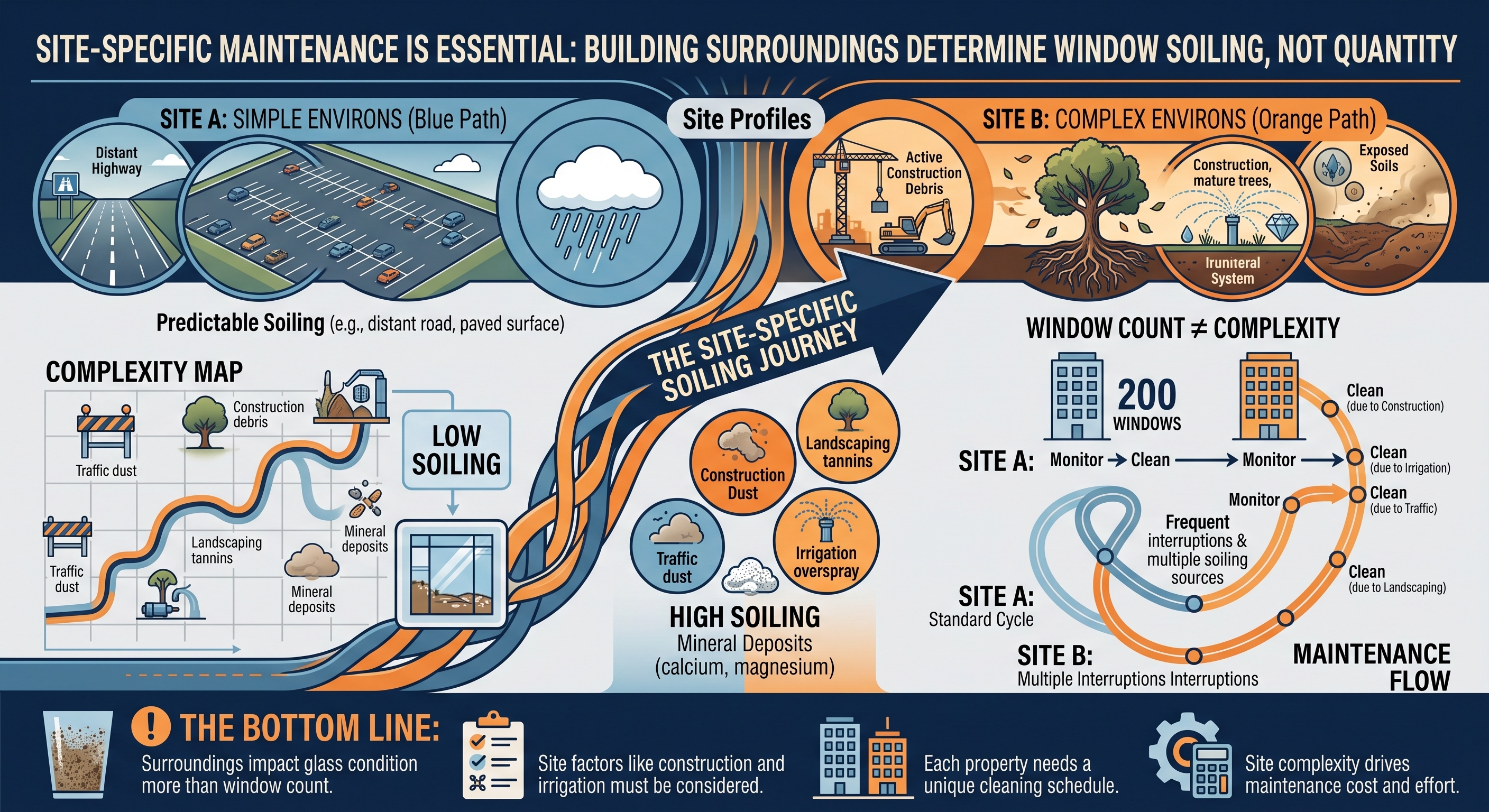
The environment immediately surrounding the property can be just as important.
Consider two otherwise similar office buildings.
One sits several hundred feet away from a major road and is surrounded primarily by paved parking.
The other sits next to active construction, irrigation systems, mature trees, landscaping, and exposed soil.
Even if both buildings experience exactly the same rainfall and temperature, their glass may not remain in the same condition for the same amount of time.
The IWCA specifically notes that glass soiling can vary by location and that hard-water spotting can be influenced by sprinkler operation and the mineral content of the water.
The IWCA's technical discussion of glass cleaning frequency addresses these site-specific factors.
This is why window cleaning frequency should be viewed as a property-specific maintenance decision.
The question isn't just how long it has been since the previous cleaning.
It's what happened during that time.
Hard Water Is a Good Example of Why Appearance Can Be Misleading
Hard-water spotting illustrates the difference between reactive and preventive maintenance particularly well.
Water from irrigation systems, building runoff, or other sources can repeatedly contact exterior glass.
When that water evaporates, dissolved minerals can remain behind.
One exposure may not create an alarming visual problem.
Repeated exposure is different.
The IWCA categorizes hard-water stains among the deposits professional window cleaners encounter during non-routine cleaning and restoration work. Its guidance emphasizes that different deposits can require progressively more specialized methods and that inappropriate removal methods can damage glass, coatings, or adjacent materials.
The IWCA provides additional guidance on non-routine window cleaning and stain removal here.
That creates an important maintenance principle:
The goal isn't always to clean glass the moment it becomes ugly. Sometimes the goal is to intervene before a routine condition becomes a restoration problem.
Construction Creates an Even Stronger Case for Early Cleaning
Construction and renovation work can dramatically change the environment surrounding a building.
Concrete, mortar, paint, adhesives, dust, sealants, and other materials can find their way onto architectural glass.
Industry guidance developed by glass and window-cleaning organizations specifically warns against allowing certain construction materials to remain on glass surfaces.
The joint guidance reproduced in the IWCA Guide to Architectural Glass for Professional Window Cleaners advises against allowing splashed materials to dry on glass and emphasizes appropriate procedures for cleaning architectural glass.
View the IWCA Guide to Architectural Glass for Professional Window Cleaners.
Separate industry guidance also notes that extended construction schedules may require multiple cleanings to prevent significant accumulation of soil and debris.
Read the architectural glass cleaning procedures referenced by the IWCA here.
This is one of the clearest examples of why appearance alone can be a poor maintenance trigger.
If potentially problematic material reaches the glass, waiting until someone thinks the building looks bad isn't necessarily the appropriate response.
Reactive Cleaning Can Make Budgeting Harder Too
There is also an operational reason to consider scheduled maintenance.
Reactive maintenance is unpredictable.
Someone notices the windows.
A tenant complains.
Leadership is visiting.
A major event is approaching.
A property inspection gets scheduled.
Suddenly, the windows need to be cleaned immediately.
That puts the property manager in a position of trying to schedule around weather, technician availability, building access, tenants, equipment, and other variables at the last minute.
A recurring maintenance plan changes the conversation.
Instead of asking:
“How quickly can someone get here?”
The conversation becomes:
“When should this building be serviced next based on its exposure and condition?”
Those are fundamentally different approaches.
One responds to a problem.
The other attempts to manage it.
Cleaning Frequency Should Be Based on Exposure
This doesn't mean every building needs more window cleaning.
In some cases, the opposite may be true.
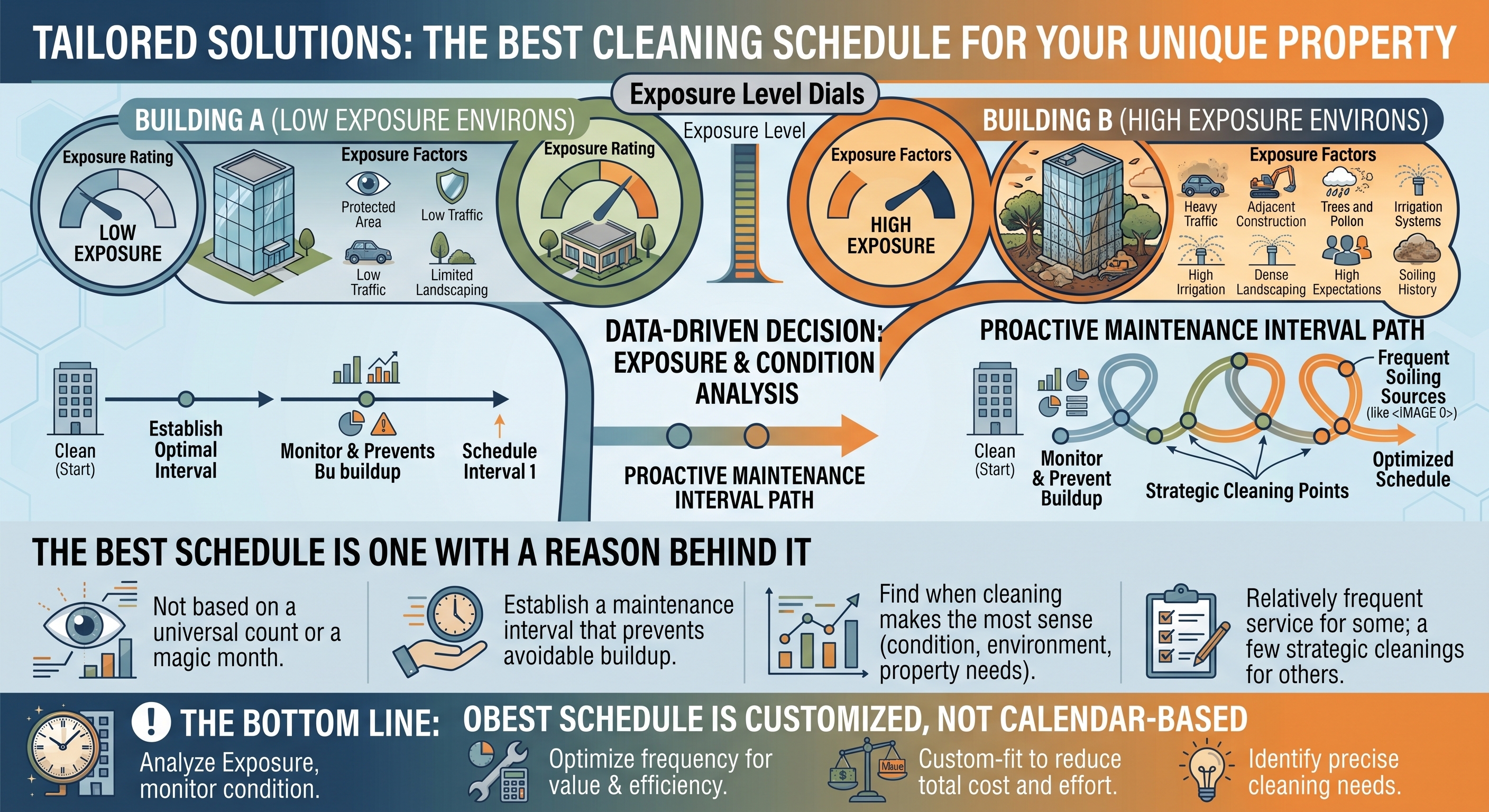
A property with relatively protected glass, minimal traffic, limited landscaping, little irrigation exposure, and low appearance requirements may be perfectly suited to a longer interval between cleanings.
The objective isn't to maximize the number of cleaning visits.
The objective is to identify the point where another cleaning provides meaningful value to the property.
That requires considering several factors:
- Building location
- Surrounding traffic
- Construction activity
- Landscaping
- Irrigation systems
- Tree and pollen exposure
- Building orientation
- Rainfall and runoff
- Type of business
- Customer and tenant expectations
- Glass condition
- Previous cleaning history
This is why the best maintenance schedule often emerges after observing the property over time.
Stop Asking Whether the Windows Look Dirty
There is nothing wrong with visually inspecting your building.
Appearance matters.
For storefronts, offices, restaurants, hotels, medical facilities, and other customer-facing properties, appearance can be one of the primary reasons for cleaning the glass in the first place.
But appearance shouldn't necessarily be the only measurement.
A comprehensive inspection starts by asking the right questions.
For example:
"How long has it been since the last cleaning?"
"What season has the building just gone through?"
"Has nearby construction occurred?"
"Are sprinklers repeatedly hitting the glass?"
Are mineral deposits beginning to appear?
"Has pollen or dust accumulation increased?"
"Is runoff developing beneath architectural features?"
"What condition was the glass in during the previous cleaning?"
Those questions create a much more useful picture than simply walking outside and deciding:
“Looks clean enough.”
The Best Cleaning Schedule Is the One Built Around Your Property
There isn't a magic month when every commercial building in Tulsa should have its windows cleaned.
There isn't a universal number of cleanings that works for every office, storefront, warehouse, medical facility, or commercial property.
And there isn't a rule saying you should wait until your windows look terrible before calling someone.
Research and industry guidance point toward something much more practical:
Evaluate the environment, understand the exposure, monitor the condition of the glass, and establish a maintenance interval that prevents avoidable buildup.
For one building, that may mean relatively frequent service.
For another, it may mean only a few strategically timed cleanings throughout the year.
The important part is that the schedule has a reason behind it.
Because ultimately, the best time to clean your building isn't necessarily when it looks dirty. It's when cleaning makes the most sense for the condition of the glass, the environment surrounding it, and the needs of the property.
Need Help Determining the Right Schedule for Your Building?
At Squeegee Squad Tulsa, we don't believe every commercial property should automatically be placed on the same cleaning schedule.
We look at the building, its surroundings, environmental exposure, glass condition, accessibility, appearance standards, and previous cleaning history to help determine a maintenance plan that makes sense for the property.
The goal isn't to clean your windows more often than necessary.
It's to clean them at the right time.
If you're unsure whether your building should be serviced monthly, quarterly, semi-annually, annually, or somewhere in between, contact Squeegee Squad Tulsa and let's build a cleaning plan around your actual property.
About the Author
Treshaun Williams is the Content Manager at Squeegee Squad Tulsa. He documents the people, processes, equipment, and planning behind professional window cleaning throughout the Tulsa area. His content focuses on giving property managers and business owners a clearer look at what happens behind the scenes of commercial window cleaning and the factors that can affect their properties. While Tre isn’t a professional window cleaner himself, his role gives him a front-row view of the industry.
Tags: Commercial Window Cleaning, Window Cleaning Education, Property Management, Building Maintenance, Commercial Building Maintenance, Window Cleaning Safety, High-Rise Window Cleaning, Building Access, Window Cleaning Costs, Tulsa Window Cleaning, Oklahoma Window Cleaning, Facility Management