
 By
By
Key Takeaways
- A change in building ownership or management provides an opportunity to reevaluate the property's window cleaning program instead of automatically inheriting the previous schedule.
- Environmental conditions, building access, surrounding construction, tenant expectations, and the existing condition of the glass can all affect what type of service a property requires.
- Property managers should understand the scope of work and access requirements behind a window cleaning proposal, particularly when elevated or rope-descent work is involved.
When a commercial building changes ownership or property management, the transition usually triggers a review of the property's existing operations. Vendor agreements, landscaping, HVAC maintenance, janitorial services, security, insurance, and other recurring services may all be examined by the incoming management team.
Window cleaning should be part of that review.
It can be tempting to simply continue whatever schedule the previous property manager had in place. If the building was cleaned quarterly, continue quarterly. If it was cleaned twice a year, continue twice a year.
But that approach assumes the previous schedule accurately reflects the building's current needs.
Research and guidance surrounding commercial building maintenance suggest a different approach: maintenance decisions are most effective when they are based on current operating conditions rather than habit alone.
For a new property manager, taking over a building can therefore provide an opportunity to establish a new baseline for its exterior glass and determine what the property actually needs moving forward.
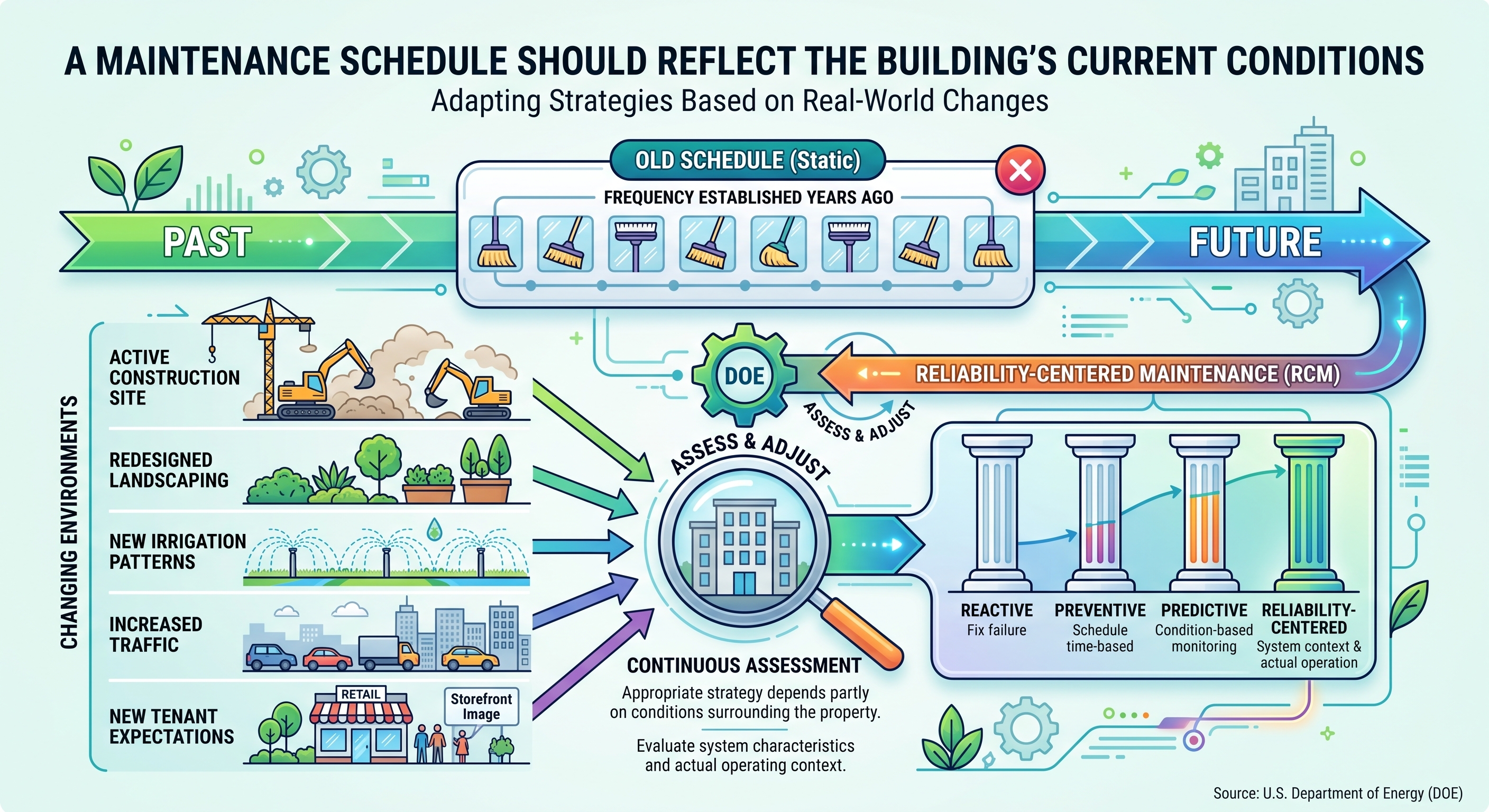
A Maintenance Schedule Should Reflect the Building's Current Conditions
One of the first questions an incoming property manager might ask is:
"How often did the previous management company have the windows cleaned?"
That's useful information, but it shouldn't necessarily determine the future maintenance schedule.
The U.S. Department of Energy's Federal Energy Management Program identifies several approaches to building operations and maintenance, including reactive, preventive, predictive, and reliability-centered maintenance. Its guidance emphasizes assessing and adjusting maintenance activities rather than treating every maintenance program as static. The Department of Energy describes reliability-centered maintenance as an approach that considers a system's characteristics and its actual operating context when determining an appropriate maintenance strategy. (U.S. Department of Energy)
Window cleaning is not the mechanical maintenance discussed in much of this guidance, but the broader principle is useful for property managers.
The appropriate maintenance strategy depends partly on the conditions surrounding the property.
A commercial building's environment can change significantly over time.
A previously empty lot may become an active construction site. Landscaping may be redesigned. Irrigation patterns can change. Traffic around the building may increase. New tenants may have different expectations for entrances and storefronts.
That means a cleaning frequency established years ago may not necessarily reflect what the building needs today.
The Environment Around the Building Matters
One reason to reassess window cleaning after a management transition is that exterior glass is constantly exposed to its surrounding environment.
Construction provides a particularly clear example.
The U.S. Environmental Protection Agency identifies construction sites, paved and unpaved roads, agricultural areas, storage piles, and other sources as contributors to fugitive dust. The EPA explains that particles from these sources can become airborne through wind or mechanical forces such as vehicle traffic. (U.S. Environmental Protection Agency)
For a property manager, that information is important because it demonstrates that exterior maintenance requirements don't exist independently of the building's surroundings.
Consider two similar office buildings.
One sits in a relatively protected development with established landscaping and limited nearby traffic.
The other sits next to an active construction project, a heavily traveled roadway, or an exposed area where wind frequently carries dust.
Even if the buildings have similar amounts of glass, their exterior surfaces are being exposed to different conditions.
That doesn't automatically mean one building requires a specific cleaning frequency. It does mean that the surrounding environment should be considered when determining an appropriate maintenance schedule.
This becomes particularly relevant when new management inherits a schedule that may have been created under completely different conditions.
Establish the Existing Condition of the Glass
Before creating a new maintenance schedule, property managers should establish what they're starting with.
When was the glass last professionally cleaned?
Were both the interior and exterior cleaned?
Were all elevations included?
Were certain windows inaccessible?
Is there evidence of mineral deposits or irrigation overspray?
Are there conditions that routine window cleaning may not correct?
These questions help separate routine maintenance from existing problems.
Not everything that makes a window look dirty is necessarily removable through standard window cleaning.
Mineral deposits can accumulate on exterior glass. Scratches, damaged coatings, failed insulated glass seals, or contamination between panes can also affect appearance.
This distinction matters because a new property manager could otherwise hire a window cleaning contractor expecting every visible imperfection to disappear.
Establishing the condition of the glass creates a baseline against which future maintenance can be evaluated.
Review What the Previous Vendor Actually Cleaned
Finding an old invoice labeled "window cleaning" doesn't necessarily tell a new property manager everything they need to know.
The actual scope matters.
For example, the previous contract may have included exterior glass but not interior glass.
Certain elevations may have been excluded.
Ground-level entrances may have received more frequent service than upper-level windows.
Specialty cleaning or restoration may have been priced separately.
Lift rental or difficult-access areas may have been excluded from the original proposal.
Understanding these details is particularly important when comparing a previous vendor's pricing with a new proposal.
A lower price does not necessarily indicate a less expensive version of the same service if the scopes are different.
Property managers should compare what is actually being performed, not simply the number at the bottom of the proposal.
Building Access Can Be More Important Than It Appears
The architecture of a commercial building can significantly affect how its windows are accessed.
Some properties can be serviced primarily from the ground. Others may require water-fed poles, ladders, lifts, roof access, or rope-descent systems.
For elevated work, these aren't simply logistical considerations.
They can involve specific safety requirements.
The Occupational Safety and Health Administration's standards for rope-descent systems require, among other things, appropriate rigging, independent personal fall-arrest systems, worker training, equipment inspection, and appropriate anchorages. OSHA also requires building owners to provide written information indicating that permanent rope-descent-system anchorages have been identified, tested, certified, and maintained before they are used. (Occupational Safety and Health Administration.)
That makes building access an especially important consideration during a management transition.
A new property manager responsible for a multi-story building should understand whether the property has existing anchorages, whether documentation exists, and how the window cleaning contractor plans to access elevated glass.
Window cleaning is not only about how much glass exists. How that glass can be safely reached can be equally important.
Don't Automatically Continue the Previous Cleaning Frequency
If the previous property manager scheduled window cleaning four times per year, that doesn't automatically mean four times per year is correct.
The building might need more frequent service.
It might need less.
Different portions of the same property may even benefit from different schedules.
A ground-level entrance exposed to fingerprints and pedestrian traffic experiences different conditions than upper-level exterior glass.
Windows located near sprinklers may experience different conditions than glass on another elevation.
Areas facing a busy roadway or construction project may accumulate contamination differently from protected portions of the property.
Instead of beginning with an arbitrary number of cleanings, property managers can begin with a more useful question:
What level of appearance are we trying to maintain, and how quickly does this particular property move away from that standard?
The answer can help establish a maintenance schedule based on observable conditions rather than habit.
Use the First Cleaning as a Baseline
For a property under new management, the first professional window cleaning can serve another purpose beyond improving appearance.
It can establish a baseline.
Once the glass has been professionally cleaned, management can begin observing how quickly different areas become visibly contaminated.
After one month, what does the building look like?
After three months?
Which elevations become dirty first?
Are the entrances requiring attention before the rest of the property?
Is irrigation causing recurring spotting?
Is nearby construction affecting one side of the building?
Those observations can help management and the contractor develop a more informed maintenance schedule.
This approach also aligns with the broader concept of condition-based maintenance: observe actual conditions and use that information to make future maintenance decisions.
A Management Change Is an Opportunity to Reset Expectations
Changing ownership or property management can create a substantial amount of administrative work.
But it also provides an opportunity to question routines that may have existed for years without being reevaluated.
Window cleaning is one of them.
Instead of simply asking what the previous management company did, consider asking:
What condition is the glass currently in?
What environmental factors affect this property?
Which areas are included in the cleaning scope?
How will technicians access difficult windows?
Are there existing conditions that standard cleaning won't correct?
What safety or building documentation may be required?
How frequently does the property actually need service?
The goal isn't automatically to increase the amount of window cleaning being purchased. The goal is to establish a maintenance program that makes sense for the property as it exists today.
Taking Over a Commercial Property in Tulsa?
If you've recently taken over the management of a commercial property, Squeegee Squad Tulsa can help evaluate the building's current window cleaning needs.
Instead of automatically continuing an existing schedule, the property can be evaluated based on its glass, architecture, access requirements, surrounding environment, and desired level of appearance.
From there, a clearly defined scope and maintenance schedule can be established around the actual property.
About the Author
Tre Williams is the Content Manager at Squeegee Squad Tulsa, where he researches and creates educational content surrounding commercial window cleaning, property maintenance, vendor selection, safety, and the questions property managers should consider when maintaining their buildings.
Tre approaches these topics from a content and research perspective rather than as a professional window cleaning technician. Technical recommendations for an individual property should be evaluated by qualified professionals familiar with the building, equipment, glass, and site conditions.
Tags
Commercial Window Cleaning, Property Management, Property Managers, Building Maintenance, Facility Management, Window Cleaning Tulsa, Tulsa Property Management, Commercial Property Maintenance, Vendor Management, Preventive Maintenance