
 By
By

Key Takeaways
- Price should be one part of vendor evaluation, not the entire evaluation. Capability, insurance, safety, reliability, communication, and scope should also be considered.
- A detailed proposal is easier to evaluate than a vague number. Property managers should understand exactly what is included, excluded, and expected before work begins.
- Vendor selection does not end when the contract is signed. Performance, communication, documentation, and reliability should continue to be evaluated throughout the relationship.
Choosing a vendor can look simple from the outside. Find a company that provides the service you need, request a quote, compare the price, and hire someone.
For property managers, however, vendor selection can involve considerably more than price.
A vendor may be given access to an occupied building, work around tenants or customers, interact with building staff, operate equipment on the property, perform work at height, or complete services that directly affect the condition and appearance of the building.
The International Facility Management Association describes vendor management as a discipline that includes defining the scope of work, establishing service expectations, verifying compliance, monitoring performance, and managing the relationship over time.
For a property manager who is new to selecting contractors, this creates an important distinction:
You are not simply purchasing a service. You are selecting a company that will become part of the way your property operates.
Start by Defining What You Actually Need
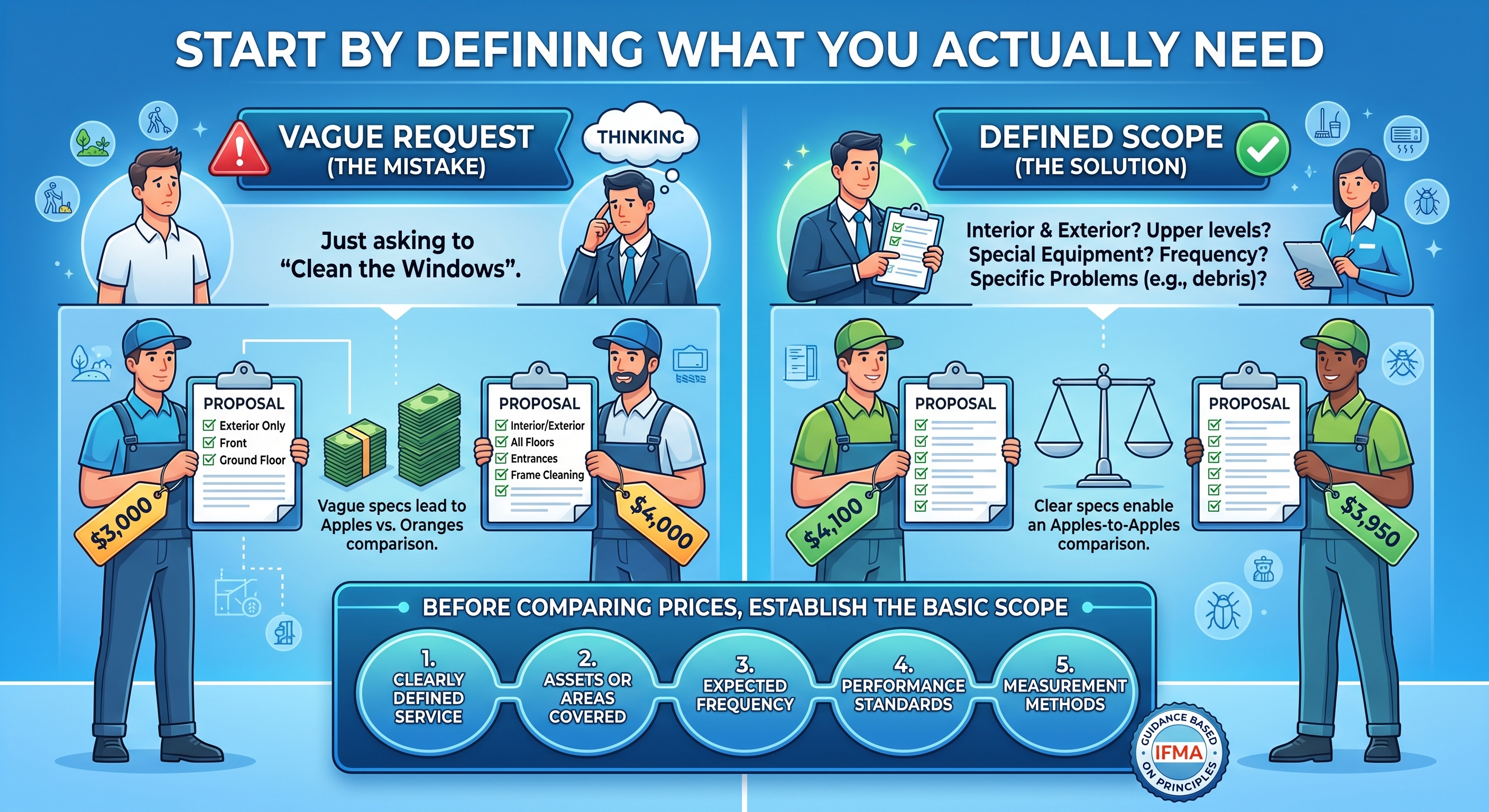
One of the easiest mistakes for a new property manager to make is requesting bids before clearly defining the problem.
Consider something as straightforward as commercial window cleaning.
A property manager might request a quote to "clean the windows," but that description leaves several unanswered questions.
Does the service include interior and exterior glass? Are entrances included? What about upper-level windows? Is specialized access equipment required? Are mineral deposits or construction debris present? How frequently should the property be serviced?
The same issue applies to landscaping, janitorial services, HVAC maintenance, pressure washing, pest control, roofing, and many other contracted services.
Before comparing vendors, establish the basic scope.
The International Facility Management Association's guidance on vendor and service contract management emphasizes the importance of clearly defining the service, assets or areas covered, expected frequency, performance standards, and methods of measuring the work.
This matters because two vendors may appear to be bidding on the same project while actually proposing two different scopes.
A $3,000 proposal is not necessarily cheaper than a $4,000 proposal if the second vendor is providing significantly more work.
Before comparing prices, make sure you are comparing the same job.
Do Not Automatically Treat the Lowest Bid as the Best Bid
Budget responsibility is an unavoidable part of property management. Controlling operating expenses matters, and competitive bidding can help determine whether pricing is reasonable.
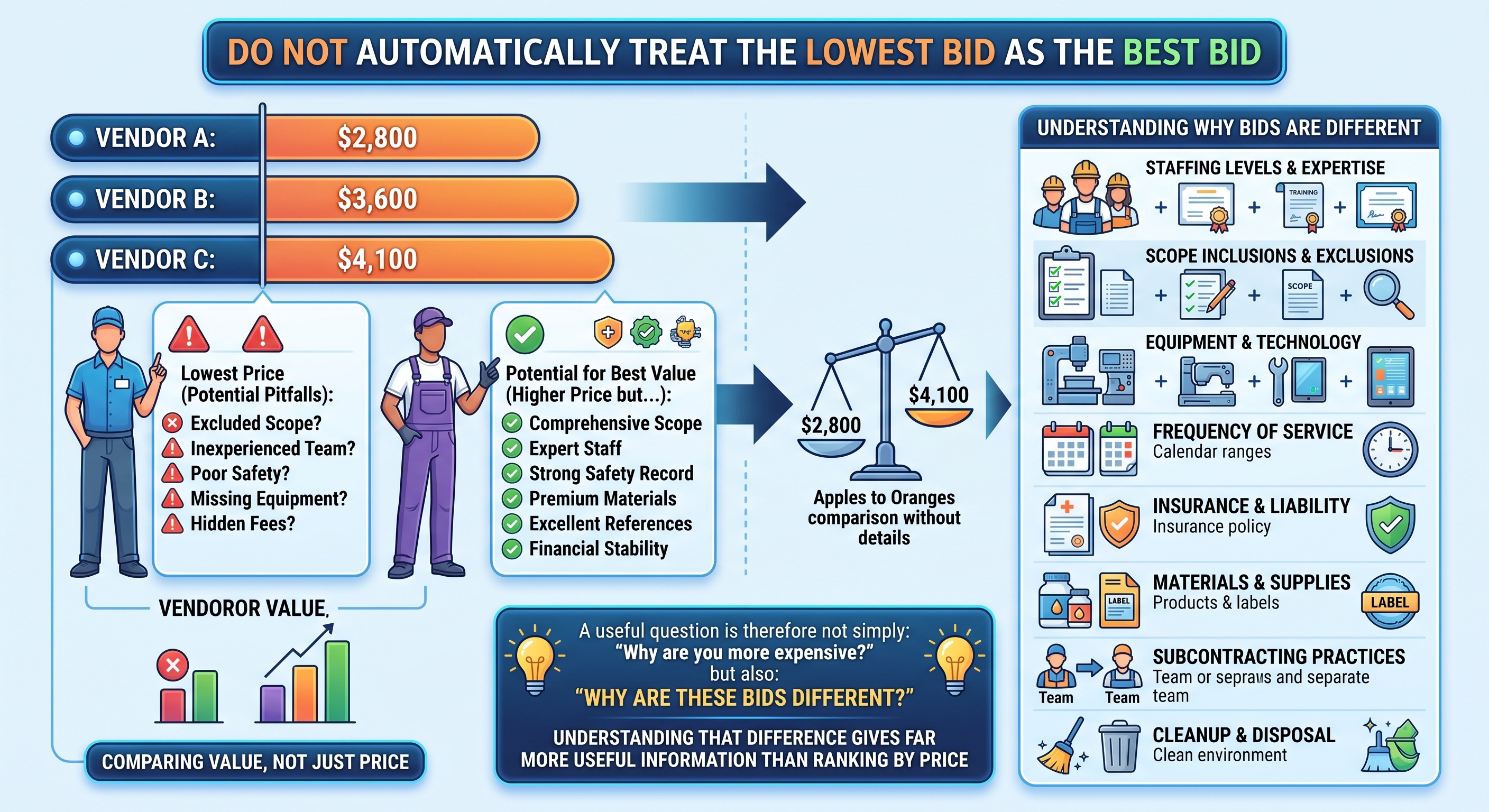
But lowest price and best value are not always the same thing.
IFMA's vendor-management guidance recommends considering factors such as technical capability, safety performance, references, financial stability, and overall fit alongside price when evaluating potential vendors.
This does not mean the most expensive vendor should automatically win either.
Instead, the goal should be understanding why the prices are different.
Suppose three vendors submit proposals:
Vendor A: $2,800
Vendor B: $3,600
Vendor C: $4,100
The numbers alone tell you very little.
Vendor A may have found a more efficient way to complete the project.
Or Vendor A may have excluded something the other companies included.
The difference could involve staffing, equipment, frequency, insurance, subcontracting, access methods, cleanup, materials, or simply different interpretations of the requested scope.
A useful question is therefore not simply:
"Why are you more expensive?"
It is also:
"Why are these bids different?"
Understanding that difference gives a property manager far more useful information than ranking proposals from cheapest to most expensive.
Verify Insurance Before Work Begins
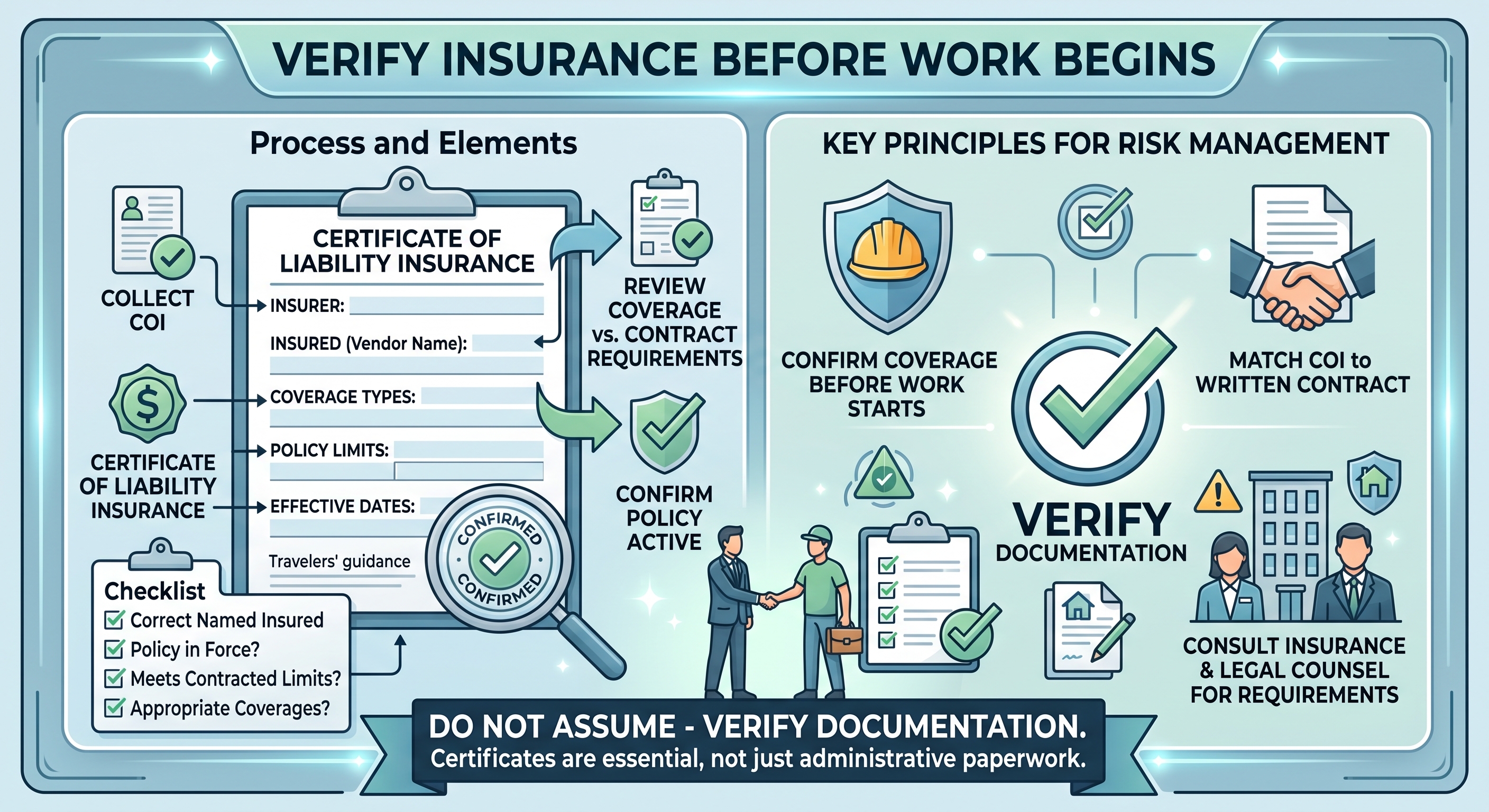
Insurance documentation can feel like administrative paperwork until an incident occurs.
That is why it deserves attention before a vendor begins working on the property.
A Certificate of Insurance, commonly called a COI, provides evidence that insurance coverage was in force when the certificate was issued and summarizes information such as coverage types, policy limits, and effective dates.
Travelers explains that certificates of insurance are commonly requested in vendor and contractor relationships so organizations can confirm that appropriate coverage is in place.
However, a COI should not simply be collected and forgotten.
Travelers' vendor risk-management guidance recommends reviewing certificates before work begins and confirming that the coverage corresponds with the requirements established in the written contract.
Requirements will vary depending on the property, vendor, work being performed, and the organization's risk policies.
For that reason, property managers should work with their organization's insurance professional or legal counsel when determining appropriate coverage requirements.
The larger lesson for a beginner is straightforward:
Do not assume a vendor is properly insured simply because they say they are. Verify the documentation required by your organization.
Look at Safety as Part of Vendor Selection
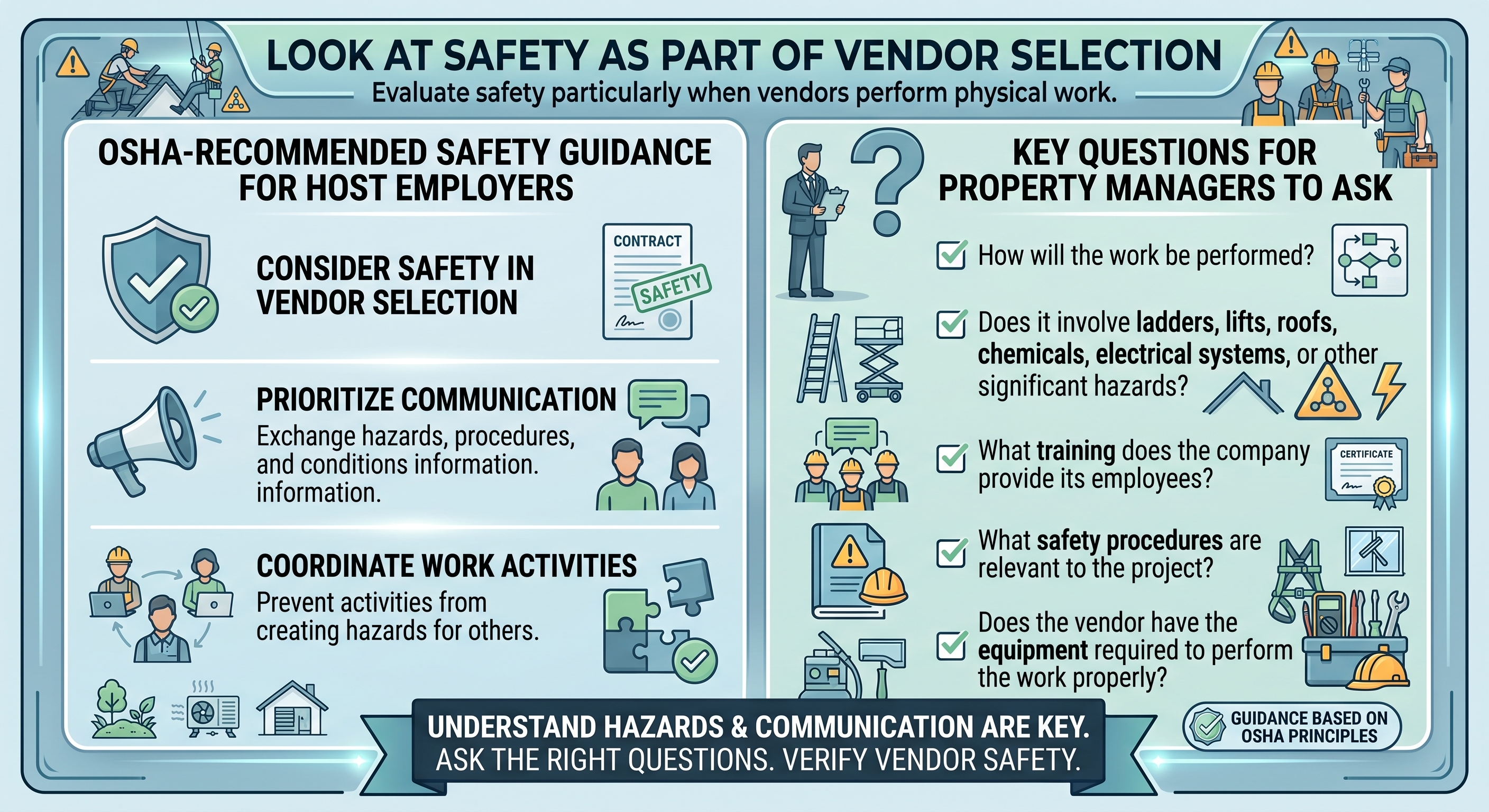
Safety becomes particularly important when vendors perform physical work on a property.
A landscaping crew operating equipment, an HVAC technician accessing mechanical systems, a roofer working above an occupied property, and a window cleaner using ladders, lifts, or rope-access systems introduce very different hazards.
The Occupational Safety and Health Administration specifically recommends considering safety and health during contractor and vendor selection.
OSHA also emphasizes communication between host employers and contractors regarding hazards, procedures, responsibilities, and changes in site conditions.
Its guidance for host employers and contractors recommends exchanging relevant safety information before work begins and coordinating work so that the activities of one employer do not unnecessarily create hazards for others.
For property managers, you do not necessarily need to become an expert in how every contractor performs their trade.
You should, however, be willing to ask questions.
How will the work be performed?
Does it involve ladders, lifts, roofs, chemicals, electrical systems, or other significant hazards?
What training does the company provide its employees?
What safety procedures are relevant to the project?
Does the vendor have the equipment required to perform the work properly?
A professional vendor should generally be able to explain its process.
Check Experience That Is Relevant to Your Property
"20 years of experience" sounds impressive.
But experience should also be relevant.
A contractor that performs excellent residential work may not necessarily be equipped for a large commercial property. Likewise, a company experienced with small office buildings may not have the equipment or procedures necessary for a high-rise environment.
Instead of asking only how long a company has been operating, ask about comparable projects.
Has the vendor serviced buildings similar to yours?
Have they handled properties of a similar size?
Do they regularly work in occupied commercial environments?
Can they explain how they would approach your particular property?
References can also help.
Property-management guidance from Buildium recommends checking licensing when applicable, insurance, references, and reviews before adding a vendor to a network.
A vendor does not need to have worked on a building identical to yours, but there should be reasonable evidence that the company understands the type of work you are asking it to perform.
Pay Attention to Communication Before You Hire Them
One of the easiest things to evaluate during the bidding process costs nothing.
Communication.
How long does the company take to respond?
Do they show up when they say they will?
Do they answer questions directly?
Does the proposal arrive when promised?
If something changes, do they communicate the change?
These interactions provide a small preview of what managing the vendor may eventually be like.
This becomes especially important for property managers because the service itself may represent only part of the workload associated with a vendor.
You may also need scheduling confirmations, insurance documents, invoices, access coordination, completion reports, tenant notifications, change orders, or responses to unexpected problems.
A company can perform excellent technical work and still become difficult to manage if communication consistently fails.
Reliability is not only about completing the physical service. It is also about making the service manageable for the customer.
Ask Who Is Actually Performing the Work
Another useful beginner question is surprisingly simple:
"Who will actually be doing the work?"
The answer may be the vendor's own employees, subcontractors, or some combination of the two.
Subcontracting is not automatically a negative. Many contractors legitimately use specialized subcontractors as part of their business model.
The important issue is transparency.
If subcontractors may be involved, a property manager can ask how they are selected, supervised, insured, and held to the project's standards.
This becomes especially relevant when safety-sensitive work is involved.
OSHA's contractor guidance recognizes that properties may contain employees from multiple employers simultaneously and stresses coordination among the different organizations working at a site.
Knowing who will actually arrive at your building makes it easier to understand responsibility before the project begins.
Read the Scope of Work, Not Just the Total
The total price is probably the first thing many people look at on a proposal.
It should not be the last.
Read the scope carefully.
A useful proposal should make it reasonably clear what the vendor is promising to deliver.
Depending on the service, that may include the areas being serviced, frequency, materials, equipment, expected timeline, exclusions, payment terms, additional charges, and procedures for changes to the work.
IFMA notes that vague scopes can contribute to disputes and emphasizes creating a precise description of what the vendor will do, how frequently it will happen, what standard is expected, and how performance will be verified.
This protects both parties.
The property manager knows what they are buying.
The vendor knows what they are expected to provide.
When the scope is vague, both sides may leave the conversation with different expectations.
That is often where problems begin.
Understand How Additional Work Is Handled
Not every condition can be identified before work begins.
A contractor may discover damage, contamination, inaccessible areas, failed equipment, or another condition that changes the original project.
The important question is what happens next.
Does the vendor stop and request authorization?
Can additional charges simply appear on the invoice?
Who is authorized to approve a change?
How is additional work documented?
A good vendor relationship should establish a process for handling changes rather than improvising one after the project has already started.
For property managers working within defined operating budgets, this can be particularly important.
Predictability has financial value.
A slightly lower initial quote can become much less attractive if the final invoice is consistently difficult to predict.
Complete the Administrative Due Diligence
Vendor selection also includes administrative requirements that may have little to do with the actual service.
Depending on your organization and the vendor relationship, this can include tax documentation, contracts, insurance certificates, licenses, payment information, and internal vendor-registration requirements.
For example, the IRS explains that businesses paying independent contractors generally begin by obtaining Form W-9, which provides the contractor's correct name and taxpayer identification number for tax-reporting purposes.
Your organization's accounting department may have additional onboarding requirements.
A beginner property manager does not necessarily need to personally manage every piece of this process.
What matters is knowing that vendor onboarding should happen before the relationship becomes difficult to document later.
Evaluate the Vendor After the Job
Selecting a vendor is not the end of vendor management.
It is the beginning.
Once the service has been completed, compare the actual experience with what was promised.
Did the company arrive when expected?
Was the agreed scope completed?
Did the final invoice match expectations?
Were problems communicated?
Were occupants or building operations unnecessarily disrupted?
How did the vendor respond when something unexpected happened?
This information becomes extremely valuable the next time you need the service.
Buildium recommends tracking factors such as work quality, response times, tenant feedback, and costs over time so property managers can identify strong performers and vendors that repeatedly underdeliver.
This creates something much more valuable than a vendor list.
It creates a vendor history.
Instead of choosing from scratch every time, property managers can gradually build a network of companies whose performance has already been tested.
A Simple Vendor Evaluation Framework
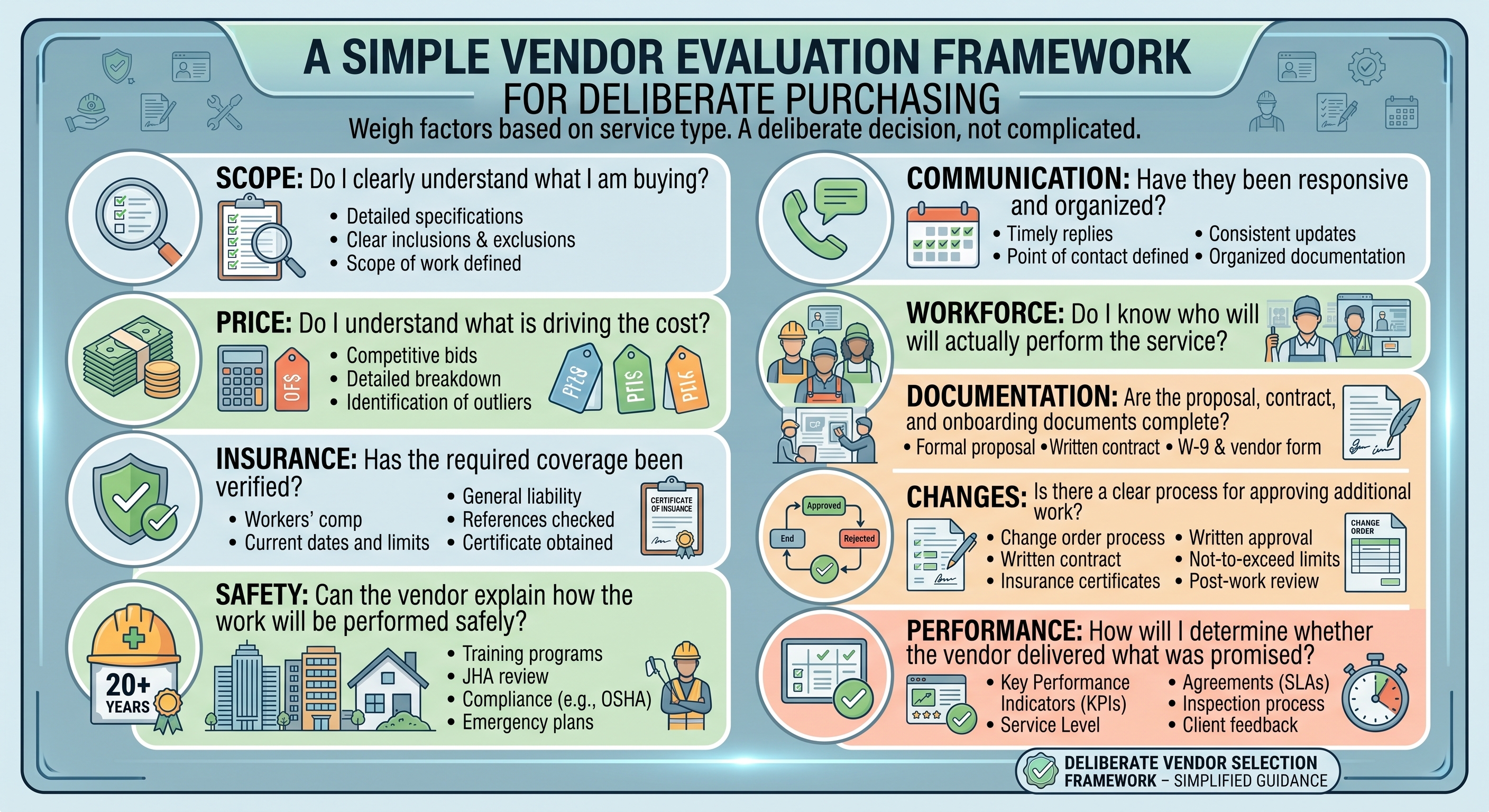
For a property manager choosing a vendor for the first time, the process does not need to become unnecessarily complicated.
Start with a few basic questions:
- Scope: Do I clearly understand what I am buying?
- Price: Do I understand what is driving the cost?
- Insurance: Has the required coverage been verified?
- Safety: Can the vendor explain how the work will be performed safely?
- Experience: Have they successfully handled comparable work?
- Communication: Have they been responsive and organized?
- Workforce: Do I know who will actually perform the service?
- Documentation: Are the proposal, contract, and onboarding documents complete?
- Changes: Is there a clear process for approving additional work?
- Performance: How will I determine whether the vendor delivered what was promised?
You may weigh these factors differently depending on the service.
The insurance and safety requirements for a company replacing a roof, for example, will naturally look different from those associated with a lower-risk service.
The point is not to make every purchasing decision complicated.
The point is to make it deliberate.
The Best Vendor May Not Always Be the Cheapest Vendor
Property managers are constantly balancing cost, building condition, tenant expectations, risk, ownership priorities, and operational demands.
Vendor selection sits directly in the middle of those responsibilities.
The cheapest vendor may sometimes be the best choice.
The most expensive vendor may sometimes be the best choice.
Neither conclusion can be reached from the price alone.
A stronger decision considers the complete relationship: scope, capability, safety, insurance, experience, communication, documentation, reliability, and cost.
Over time, the objective should not simply be finding companies willing to perform individual jobs.
It should be building a dependable network of vendors that property managers can confidently call when their buildings need them.
Because when a vendor consistently communicates, performs the agreed work, documents what happened, manages risk responsibly, and charges what was expected, they provide something property managers have very little of:
One less problem to worry about.
About the Author
Tre Williams is the Content Manager at Squeegee Squad Tulsa. He creates educational content focused on commercial property maintenance, window cleaning, vendor transparency, and the questions property managers and building owners should consider when evaluating service providers.
Tags
Property Management, Vendor Management, Property Manager Guide, Commercial Property Management, Choosing a Vendor, Vendor Selection, Facility Management, Commercial Maintenance, Contractor Selection, Property Maintenance, Vendor Risk Management, Tulsa Property Management