 By
By

-
Key Takeaways
- The number of windows is important, but it is only one part of residential window cleaning pricing. Window type, size, accessibility, height, condition, screens, tracks, interior access, and requested services can all affect the amount of labor required.
- -Two similarly sized homes can receive very different quotes. A home with simple, accessible windows may be considerably faster to service than a home containing divided panes, large picture windows, difficult second-story access, landscaping obstacles, screens, or significant buildup.
- -The condition of the glass can change the scope of the job entirely. Routine dirt and environmental debris are different from mineral deposits, paint, adhesive, oxidation, and other contaminants that may require additional treatment.
If you have ever requested quotes for professional residential window cleaning, you may have noticed that the price is not always as simple as counting the windows on your house. Two homes that appear relatively similar from the street can require very different amounts of labor, equipment, preparation, and time to clean properly.
That is because professional residential window cleaning is generally priced around the work required to complete the job, not simply the square footage of the house. The number of windows matters, but so do their design, condition, accessibility, height, screens, interior access, mineral buildup, and the actual scope of service being requested.
National consumer pricing resources reflect this complexity. This Old House reports that residential window cleaning prices can vary according to the number, size, type, condition, and location of the windows. Rather than treating every home as an interchangeable collection of pieces of glass, a more useful way to understand a quote is to examine what technicians will actually have to do once they arrive at the property.
Window Count Is the Starting Point, Not the Entire Equation
It is reasonable to assume that a house with 30 windows will generally require more work than a house with 10. Window count gives a cleaning company an initial indication of the size of a project, but counting openings alone does not explain how much work those openings require.
- Even national pricing estimates are commonly presented by pane or window rather than strictly by home square footage. HomeAdvisor notes that the number, type, size, accessibility, and requested additional services can all influence residential window cleaning costs. That distinction is important because the square footage of a home does not necessarily correspond with the amount of glass installed in it.
- A 4,000-square-foot home could have relatively few large, accessible windows, while a 2,500-square-foot home could contain numerous smaller windows, divided panes, transoms, doors, and other glass surfaces. From a window cleaner's perspective, those properties represent two completely different workloads.
- This is one reason homeowners should be cautious about estimating the price of professional window cleaning based solely on the size or value of their home. The architecture of the house and the configuration of its windows frequently provide more useful information than square footage alone.
- Not All Windows Require the Same Amount of Work
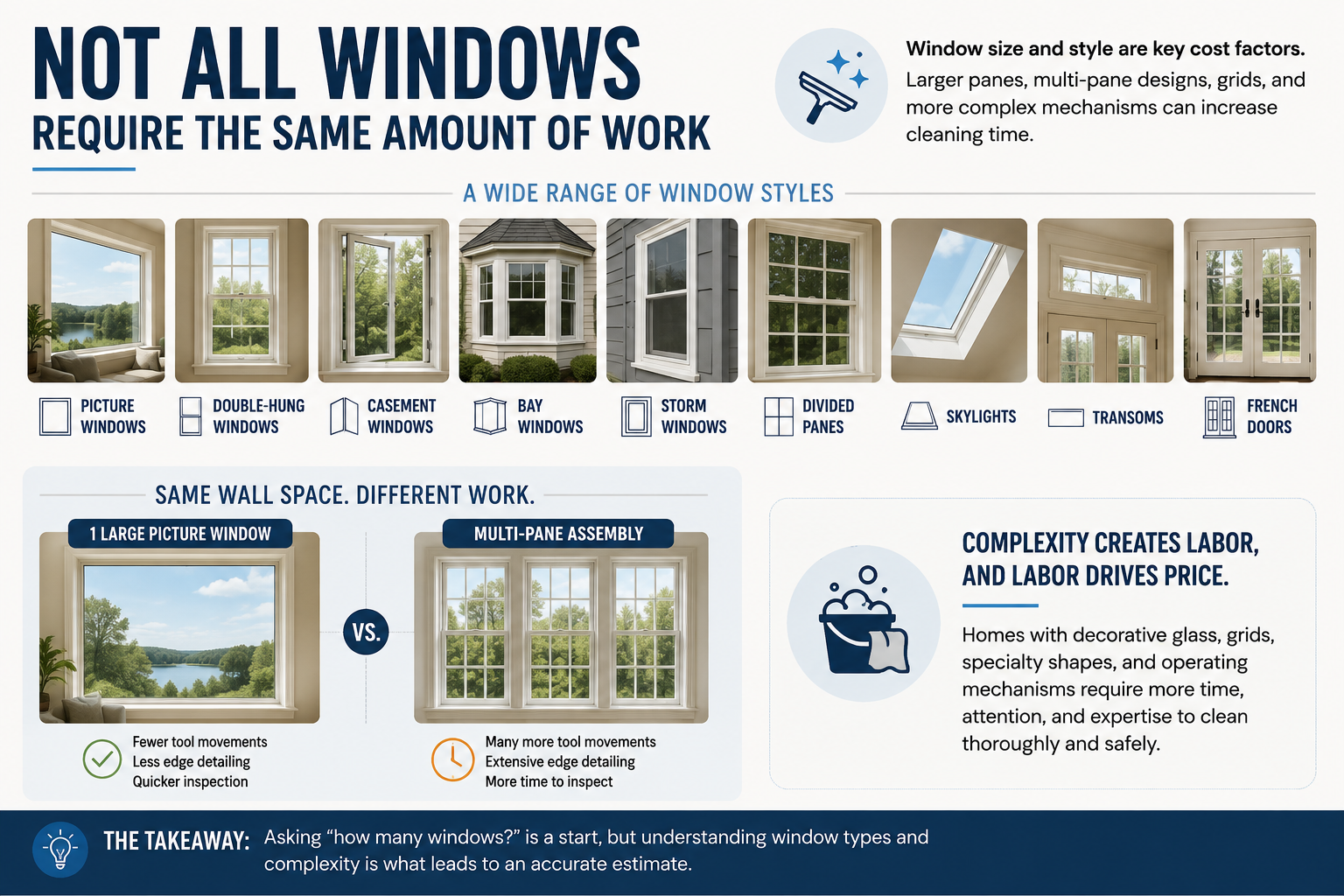
- The word "window" sounds like a standardized unit, but residential windows come in an enormous range of configurations. Picture windows, double-hung windows, casement windows, bay windows, storm windows, divided panes, skylights, transoms, French doors, and other designs can each require different cleaning techniques and different amounts of detailing.
- HomeGuide identifies window size and style as significant residential window cleaning cost factors, noting that larger panes, multi-pane designs, grids, and windows with more complex mechanisms can increase cleaning time. This helps explain why simply asking how many windows a house has may not provide enough information to produce an accurate estimate.
- Consider the difference between one large picture window and an assembly containing numerous individual panes. From across the room, both may occupy approximately the same amount of wall space. During cleaning, however, the second configuration can require substantially more individual tool movements, edge detailing, and inspection.
- This is particularly relevant in homes with decorative glass configurations. Complexity creates labor, and labor is one of the fundamental components behind service pricing.
- Accessibility Can Matter as Much as the Glass Itself
- A window can be relatively simple to clean once a technician reaches it. Reaching it safely and efficiently may be the complicated part.
- Ground-level windows with open access around the house represent a very different working environment from windows located above steep landscaping, rooflines, fences, patios, shrubs, retaining walls, or sloped terrain. Interior access can create similar challenges when windows are located behind large furniture, above staircases, in vaulted spaces, or in areas requiring additional preparation.
- This is not merely a matter of inconvenience. Working at elevation introduces legitimate safety considerations. OSHA's ladder safety guidance outlines requirements and practices involving ladder loads, positioning, inspection, and proper setup. OSHA also specifically warns that improperly positioned portable ladders can move or slip and that workers can lose their balance while using them.
- For a professional company, difficult access therefore affects more than the number of minutes spent cleaning the glass. It can influence equipment selection, setup time, technician positioning, movement around the property, and the method used to complete the work safely.
- That is why a second-story window directly accessible from stable ground may not represent the same amount of work as another second-story window positioned above a complicated roofline or landscaping feature. They may look identical from inside the house, but they are not necessarily identical jobs.
- The Condition of the Windows Makes a Major Difference
- Another important pricing variable is something homeowners may not immediately notice when requesting an estimate: what is actually on the glass.
- Routine residential window cleaning generally addresses common contaminants such as dust, fingerprints, pollen, environmental residue, and ordinary dirt. Other conditions can require substantially different processes.
- Hard water is a common example. When water containing dissolved minerals repeatedly contacts glass and evaporates, mineral residue can remain behind. Over time, those deposits can become much more difficult to remove than ordinary surface dirt. This Old House specifically identifies mineral deposits, paint, stains, and heavily soiled glass as conditions that can increase the complexity and price of professional window cleaning.
- The distinction is important because washing a window and restoring contaminated glass are not necessarily the same service. If normal cleaning methods cannot remove a deposit, additional chemicals, tools, dwell time, testing, or restoration procedures may be required.
- Paint overspray, construction debris, adhesive residue, and other contaminants can create similar complications. This is why a homeowner who has not had the windows professionally cleaned for several years may receive a different initial quote than a homeowner whose windows have been maintained consistently.
- HomeGuide similarly notes that heavily soiled windows, hard water stains, paint overspray, and adhesive residue can require specialized treatment and additional labor. In practical terms, the technician is no longer performing only routine maintenance. The condition of the surface has expanded the scope of the project.
- First-Time Cleaning and Maintenance Cleaning Are Different Situations
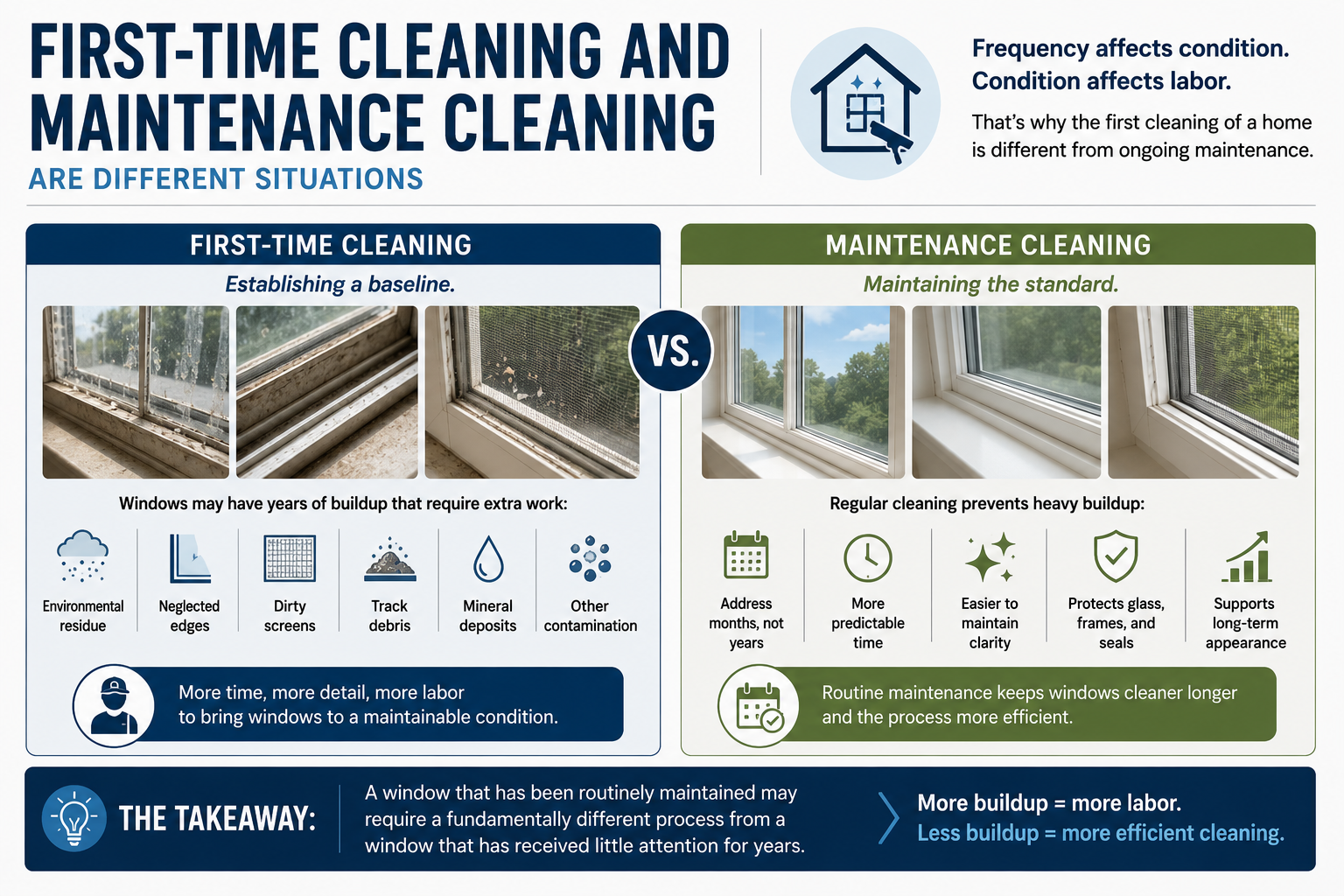
- This also helps explain why the first professional cleaning of a home can be different from subsequent maintenance visits.
- A first visit gives technicians an opportunity to establish a baseline condition. Windows that have accumulated years of environmental residue, neglected edges, dirty screens, track debris, mineral deposits, or other contamination may require additional work during that initial service.
- Once the glass has been brought to a maintainable condition, regularly scheduled cleaning may become more predictable because technicians are addressing accumulation over months rather than years. That does not mean every company automatically charges less for repeat service, but it helps explain why cleaning history can be relevant when evaluating a property.
- The broader principle is straightforward: frequency affects condition, and condition affects labor. A window that has been routinely maintained may require a fundamentally different process from a window that has received little attention for several years.
- Interior and Exterior Cleaning Are Separate Workloads
- Another major factor is whether a homeowner wants exterior cleaning only or both interior and exterior service.
- Exterior cleaning requires technicians to work around the perimeter of the property and address environmental buildup on the outside surface. Interior cleaning adds another side of every applicable window, along with the logistical requirements of working inside an occupied home.
- Interior work can involve protecting flooring, working carefully around furniture and personal belongings, removing or accessing screens, moving through multiple rooms, and coordinating access with the homeowner. The work becomes more detailed because technicians are operating within the living environment rather than exclusively outside.
- HomeGuide's residential pricing research distinguishes between service types and notes that interior-and-exterior cleaning costs more than cleaning only one side. This is an important consideration when comparing quotes because one company may be quoting exterior-only service while another is quoting a more comprehensive package.
- The total price alone therefore tells you relatively little unless you understand exactly what work the price represents.
- Screens, Tracks, Sills, and Other Details Can Change the Scope
- Glass may be the most visible component of the job, but residential windows contain more than glass.
- Screens collect dust, pollen, insects, and environmental debris. Tracks can accumulate dirt and organic material. Sills and frames can require additional wiping or detailing. Depending on the company and service package, these items may be included, offered as optional services, or priced separately.
- HomeAdvisor identifies screen washing, track and sill cleaning, and calcium deposit removal among common residential window cleaning add-ons. Angi likewise identifies screen cleaning, track and sill cleaning, and hard water stain removal as services homeowners may need to account for beyond standard glass cleaning.
- This is where quote comparisons can become misleading. Imagine that Company A quotes $300 while Company B quotes $400. At first glance, Company A appears to be significantly cheaper. If Company A is cleaning only exterior glass while Company B is cleaning interior and exterior glass plus screens and additional detailing, the two prices are not describing the same product.
- A lower number is only a lower price when the scope of work is equivalent.
- Height Introduces Time, Equipment, and Risk

- Multi-story homes provide another useful example of why window cleaning cannot always be reduced to a flat per-window calculation.
- Working higher above the ground can require ladders, extension equipment, water-fed systems, or other access methods depending on the property. Every method involves setup, movement, and safety considerations that do not exist when a technician is standing comfortably at ground level.
- OSHA's fall-protection resources include window-cleaning-specific safety standards among recognized industry guidance, including the ANSI/IWCA window cleaning safety standard addressing window cleaning access equipment. OSHA's fall protection standards page provides additional information on these window cleaning safety resources.
- The safety concern is not theoretical. OSHA has documented incidents involving workers injured while cleaning elevated windows, including residential work involving ladders and second-story access. Those cases reinforce an important point for homeowners: when a company evaluates difficult access, part of what it is evaluating is how the work can be performed without unnecessarily exposing technicians or property to risk.
- A professional quote therefore may reflect the safest practical way to reach a window, not simply the amount of glass that needs to be washed.
- The Layout of the Property Matters More Than Many Homeowners Realize
- Two houses can have the same number and type of windows and still require different amounts of time to service because the surrounding properties are different.
- One home may have wide, level access around every exterior wall. Another may have dense landscaping, narrow side yards, a pool, fencing, outdoor furniture, steep grades, roof extensions, or other obstacles around the same number of windows.
- These factors influence how efficiently technicians can move equipment around the property and transition from one window to the next. Individually, moving a ladder around a shrub or repositioning equipment around a patio may seem insignificant. Repeated across dozens of windows, however, small access complications accumulate into meaningful labor time.
- This is one reason accurate residential estimates sometimes require photographs, detailed descriptions, mapping technology, or an in-person assessment. The objective is not simply to determine how many windows exist. It is to understand what will actually be required to clean them.
We also cover this topic for commercial window cleaning in a different blog post here. - Why Online Window Cleaning Price Averages Should Be Treated Carefully
- Online pricing guides can be helpful for establishing a general range, but they should not be interpreted as universal price sheets.
- For example, This Old House reports a broad national range of approximately $8 to $40 per window for professional residential window cleaning, while HomeGuide reports typical interior-and-exterior pricing of approximately $8 to $16 per window. These figures are useful as market context, but the difference between them also illustrates why homeowners should be cautious about applying national averages directly to a specific house.
- Different sources use different assumptions about what constitutes a "window," what services are included, local labor costs, minimum service charges, window types, and property conditions. A national average cannot see your second-story picture window above a sloped flower bed, determine whether your screens need cleaning, or identify mineral deposits on your exterior glass.
- For that reason, online averages are better viewed as educational benchmarks than guaranteed local prices.
- What Homeowners Should Look for in a Window Cleaning Quote

- Instead of asking only, "How much does window cleaning cost?" a more useful question may be, "What exactly is included in this price?"
- A good residential quote should make the scope understandable. Homeowners should be able to determine whether the service includes exterior glass only or interior and exterior cleaning, whether screens are included, how tracks and sills are handled, whether difficult-access windows are part of the quoted price, and whether specialty conditions such as hard water require separate treatment.
- This makes it much easier to compare companies fairly. It also reduces the likelihood of discovering halfway through the project that something the homeowner assumed was included was actually considered an additional service.
- Price transparency matters because professional residential window cleaning is not a standardized commodity. The same phrase can describe very different levels of service.
- The Real Question Is How Much Work Your Home Requires
- There is no single factor that determines the price of residential window cleaning. The final price is better understood as the result of window quantity, design, condition, accessibility, height, requested services, and the amount of labor required to complete the work properly.
- That is why two homes of similar size can receive different quotes without either estimate necessarily being incorrect. One property may simply require more time, more equipment, more detailed work, or a different access strategy.
- For homeowners, understanding those variables makes the quoting process considerably less confusing. Instead of comparing one final number against another, you can evaluate what each company is actually proposing to do.
- And ultimately, that is the comparison that matters most.
- When you request a residential window cleaning estimate, do not be afraid to ask what went into the price. A professional company should be able to explain the scope of work, what is included, what is not included, and whether any conditions around your home could change the service required.
- About the Author
- Treshaun Williams is the Content Manager at Squeegee Squad Tulsa. He documents the people, processes, equipment, and planning behind professional window cleaning throughout the Tulsa area. His content focuses on giving property managers and business owners a clearer look at what happens behind the scenes of commercial window cleaning and the factors that can affect their properties. While Tre isn’t a professional window cleaner himself, his role gives him a front-row view of the industry.
Tags: Commercial Window Cleaning, Window Cleaning Education, Property Management, Building Maintenance, Commercial Building Maintenance, Window Cleaning Safety, High-Rise Window Cleaning, Building Access, Window Cleaning Costs, Tulsa Window Cleaning, Oklahoma Window Cleaning, Facility Management