 By
By
Property managers are expected to control expenses.

Key Takeaways
- The lowest bid does not automatically represent the lowest total cost. Additional work, change orders, repeat service, delays, and management time can change the economics of a vendor relationship.
- Cost-effective vendors should be evaluated on more than the finished product. Reliability, communication, insurance, safety, scope, and documentation can all contribute to value.
- Property managers can make better vendor decisions by tracking actual performance over time. Comparing what was promised with what actually happened makes future purchasing decisions more evidence-based.
That makes price an important part of almost every vendor decision. Whether the service involves landscaping, janitorial work, HVAC maintenance, roofing, pressure washing, window cleaning, or another building service, there is usually a budget that has to be respected.
But there is an important distinction between a vendor that is cheap and a vendor that is cost-effective.
Those two things are not necessarily the same.
A cheap vendor has a low initial price.
A cost-effective vendor provides the required result at a reasonable total cost while also accounting for factors such as reliability, scope, quality, safety, communication, and risk.
That distinction matters because the price printed at the bottom of a proposal does not necessarily represent the total cost of using that vendor.
The International Facility Management Association's guidance on vendor and service contract management specifically distinguishes between price and total cost. IFMA notes that evaluating total cost and demonstrated capability can provide a more complete picture than evaluating headline price alone.
For property managers, that creates an important question:
Are you trying to find the lowest-priced vendor, or are you trying to find the vendor that provides the best value for the property?
Start by Separating Price From Cost
Price and cost sound interchangeable, but they can describe two different things in vendor management.
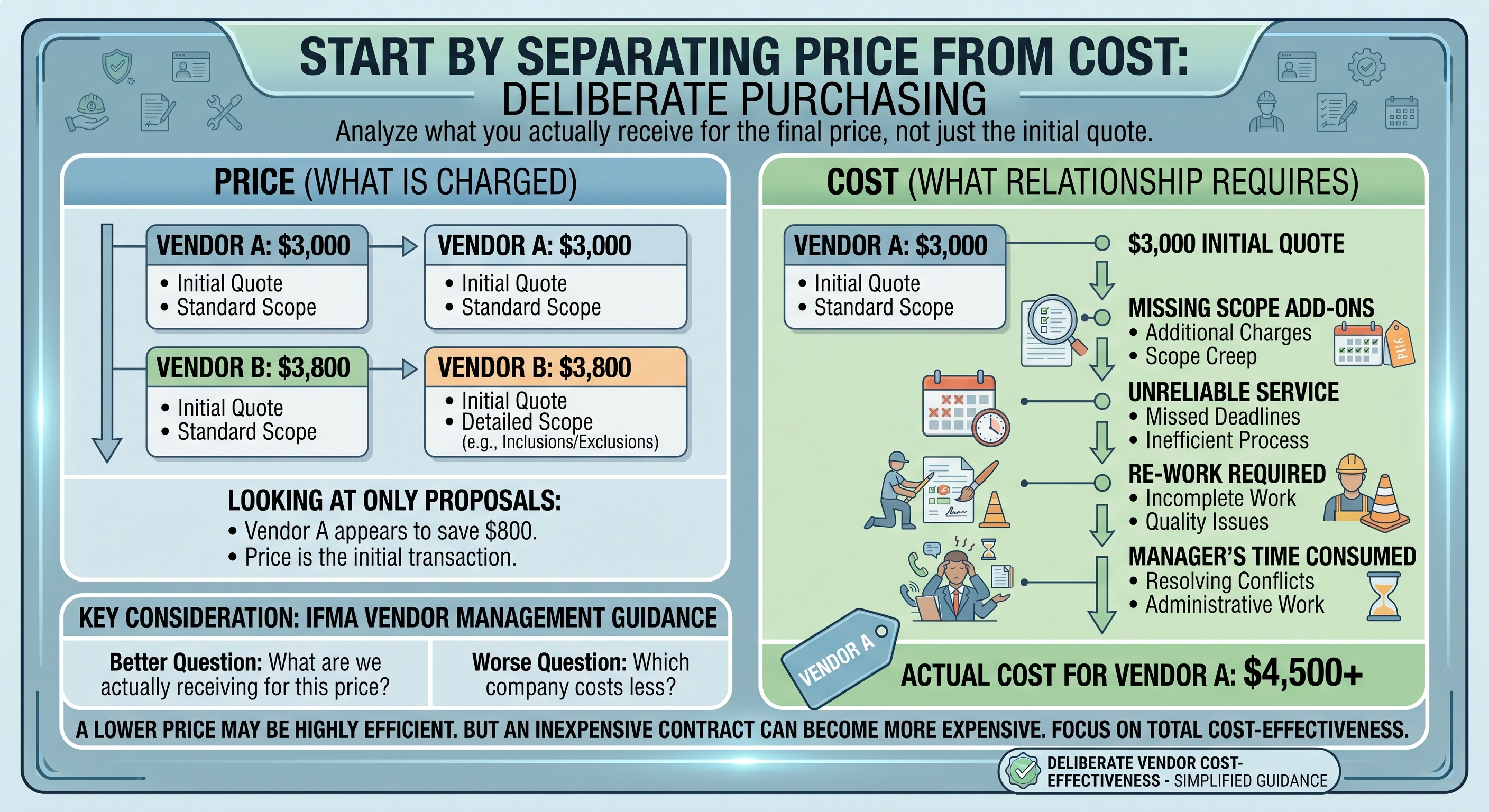
Price is what the vendor charges.
Cost is what the vendor relationship ultimately requires from the property.
Imagine that two companies submit proposals for the same service.
Vendor A: $3,000
Vendor B: $3,800
Looking only at the proposals, Vendor A appears to save the property $800.
But suppose Vendor A later requires additional charges that were not included in the original scope. Perhaps the vendor also needs to return to correct incomplete work, misses the agreed service date, or requires several hours of the property manager's time resolving issues.
The original $800 difference begins to mean something different.
That does not mean the cheaper vendor will always perform worse. A lower-priced company may be highly efficient, properly equipped, well managed, and perfectly capable of completing the job.
The important point is that initial price alone cannot tell you which vendor is more cost-effective.
IFMA's vendor-management guidance warns that a contract that appears inexpensive on paper can become the more expensive option when unreliable service and repeated change orders are taken into account.
For property managers, the better comparison is therefore not simply:
"Which company costs less?"
It is:
"What are we actually receiving for this price?"
Make Sure the Lower Bid Includes the Same Work
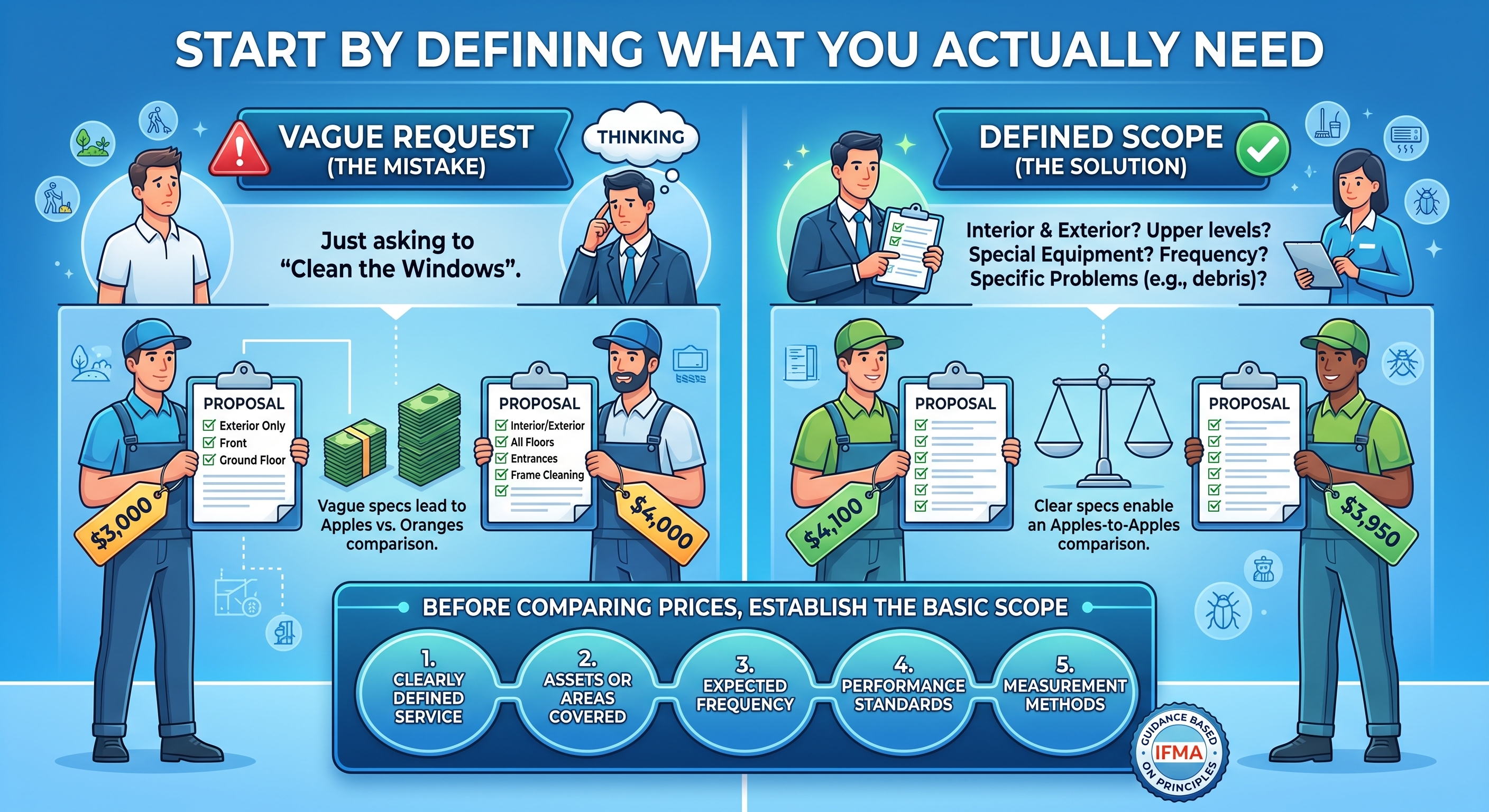
One of the first things to investigate when one proposal is substantially cheaper than another is the scope.
Consider commercial window cleaning as an example.
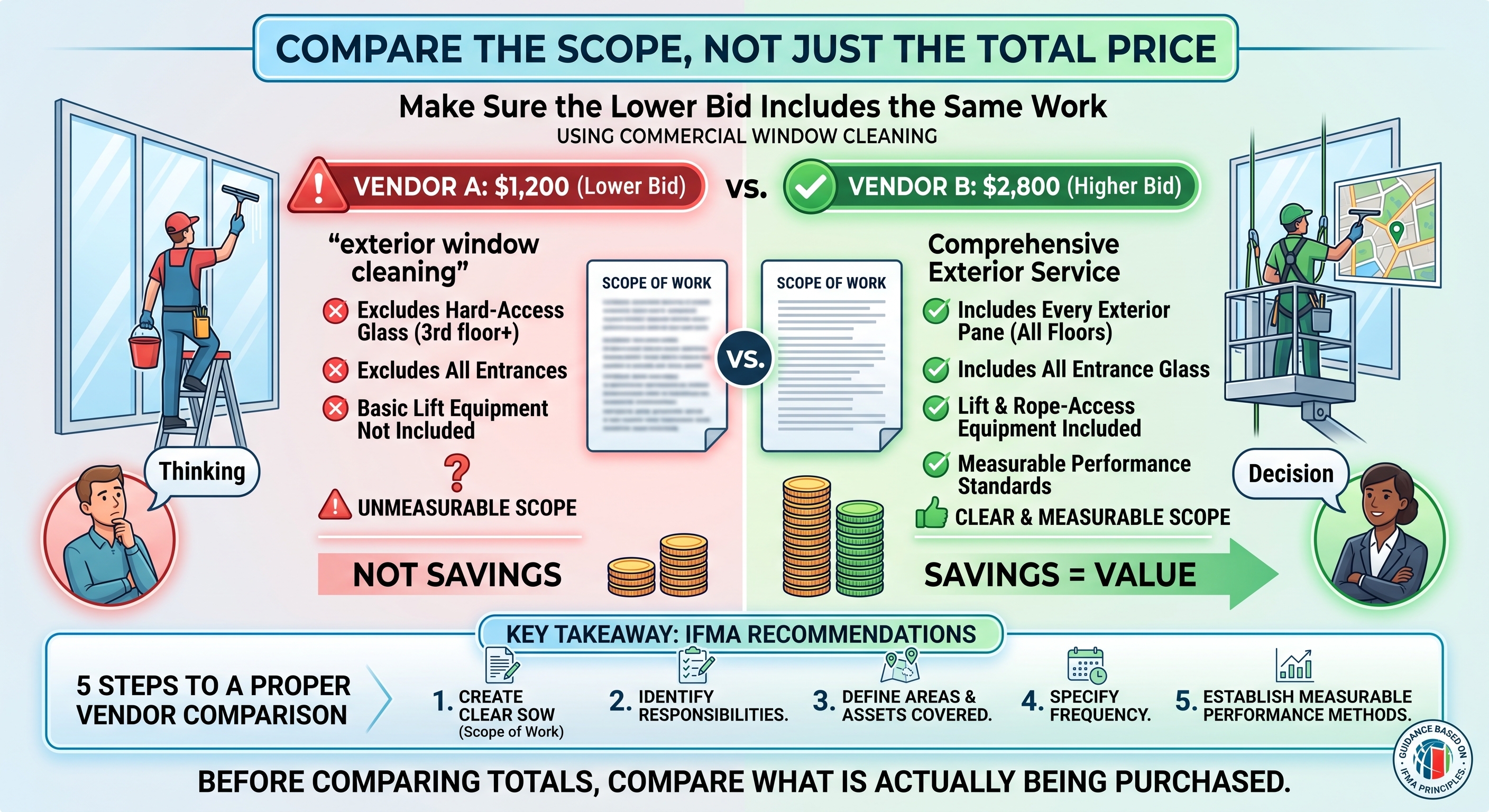
Two companies might both submit proposals labeled "exterior window cleaning," but their interpretation of the project could be different.
One may include every exterior pane.
Another may exclude difficult-access glass.
One may include entrance glass.
Another may treat entrances as an additional service.
One may have included the lift or specialized access equipment required to complete the property.
Another may charge separately for it.
Neither proposal can be evaluated correctly until the property manager understands those differences.
The same principle applies to virtually any contracted building service.
A lower price created by a smaller scope is not necessarily a savings.
Before comparing the totals, compare what is actually being purchased.
Look for Costs That Appear After the Proposal
One of the clearest differences between a cheap vendor and a cost-effective vendor may not become visible until after work begins.
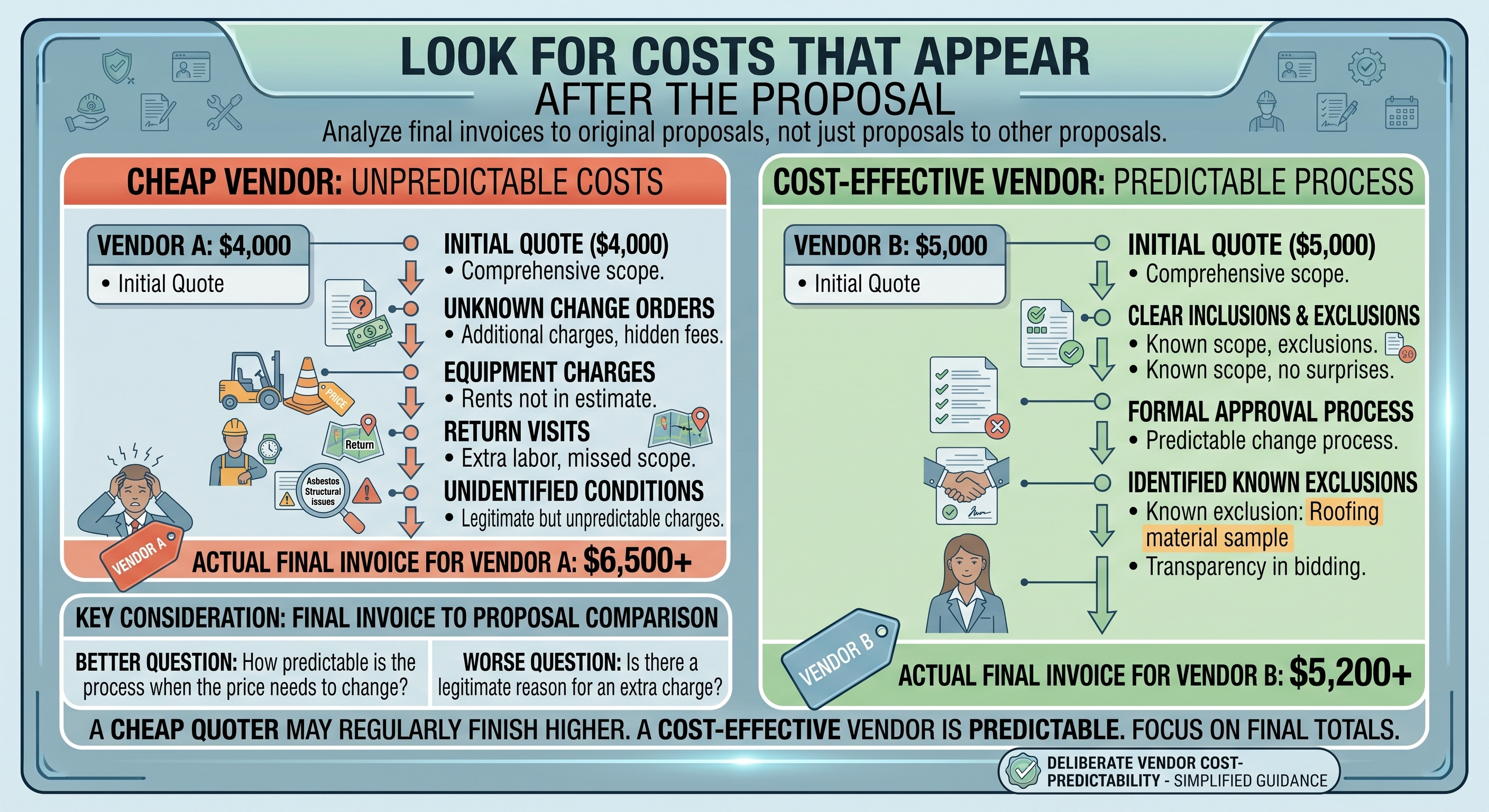
Additional costs can appear in several ways.
There may be change orders.
There may be equipment charges.
There may be additional labor.
There may be areas that were excluded from the original estimate.
There may be return visits.
There may be charges associated with conditions that were not identified during the bidding process.
Some additional charges are completely legitimate. Buildings are complex environments, and contractors can encounter conditions that could not reasonably have been identified beforehand.
The question is not whether a vendor will ever charge more than the original estimate.
The better question is:
How predictable is the process when the price needs to change?
A cost-effective vendor should generally be able to explain what is included, identify known exclusions, and establish how additional work will be approved.
That predictability has value.
If one contractor charges $5,000 and reliably finishes around $5,000 while another quotes $4,000 but regularly finishes significantly higher, the proposal price alone provides an incomplete comparison.
Property managers should therefore compare final invoices to original proposals, not simply proposals to other proposals.
Consider the Cost of Doing the Work Twice
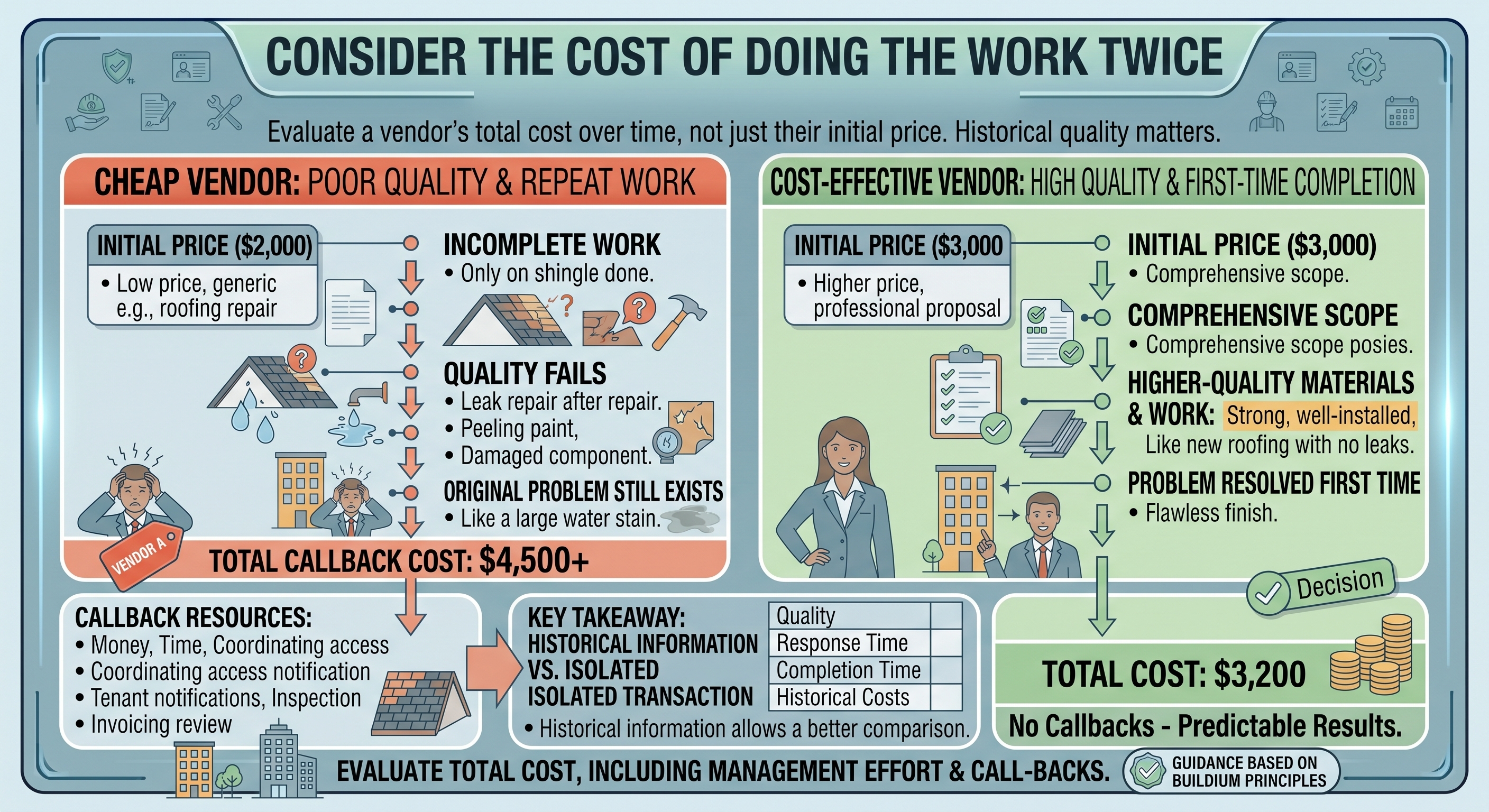
The price of a service becomes considerably less attractive if the service has to be repeated.
This can happen when work is incomplete, quality does not meet expectations, or the original problem was never properly addressed.
A vendor who charges less but regularly requires callbacks may consume more resources than a vendor whose initial price is higher but whose work consistently meets the agreed standard.
Those resources can include more than money.
The property manager may have to schedule another visit.
Building access may need to be coordinated again.
Tenants may need another notification.
Staff may need to inspect the work again.
Invoices may need additional review.
The vendor may need additional communication and supervision.
Property-management guidance from Buildium recommends tracking vendor work quality, response time, completion time, and historical costs rather than evaluating contractors solely on individual transactions.
That type of historical information allows a property manager to identify something that a quote cannot show:
How expensive is this vendor to manage over time?
Management Time Is Part of the Equation
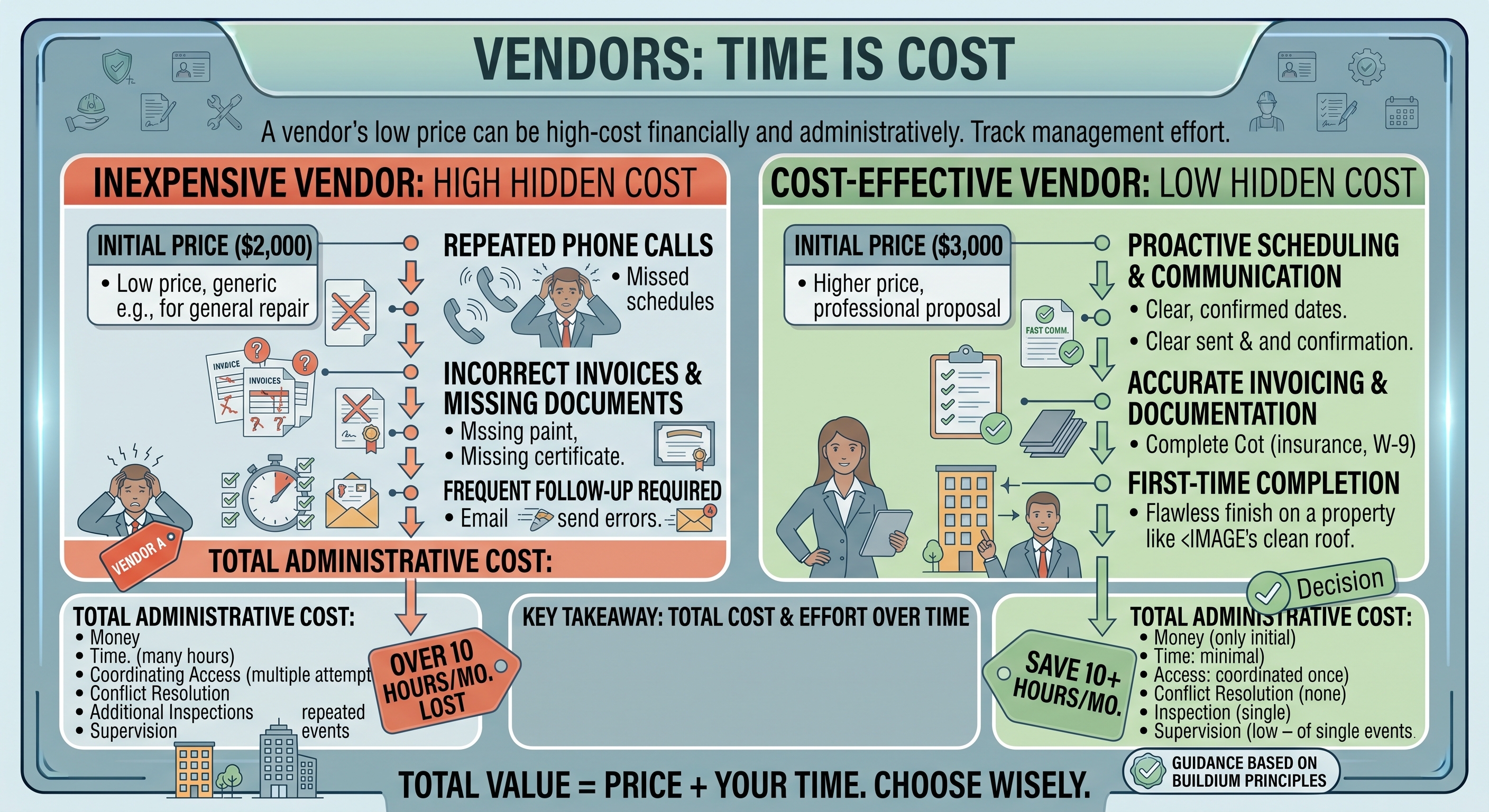
This cost is easy to overlook because it may never appear on an invoice.
A vendor can be inexpensive financially while being expensive administratively.
Imagine one contractor who requires repeated phone calls to confirm a schedule, regularly sends incorrect invoices, forgets documentation, arrives without proper access information, and needs frequent follow-up.
Now compare that with a vendor that confirms scheduling, communicates changes, provides the required documents, completes the agreed work, and sends an accurate invoice.
Even if the second vendor charges more, the relationship may require considerably less management.
That matters because a property manager's time has value.
Every hour spent resolving a preventable vendor problem is an hour that cannot be spent addressing another property, tenant issue, capital project, inspection, owner request, or operational priority.
Recent Buildium guidance on property-management vendor networks emphasizes tracking vendor response time and completion time alongside costs and work quality.
A cost-effective vendor therefore does more than perform a service.
They reduce the amount of work required to manage that service.
Reliability Has Economic Value
A missed service appointment does not necessarily produce an invoice.
It can still create a cost.
Suppose a property manager schedules work around tenant operations, building access, security, parking restrictions, or another contractor.
If the vendor fails to appear, the property manager may have to coordinate those arrangements again.
The effect becomes more significant when the service is time-sensitive.
A landscaping issue before an important event, an HVAC problem during extreme weather, a janitorial failure before tenants arrive, or an exterior cleaning project scheduled around building operations can all create consequences beyond the service itself.
This is one reason vendor performance should be evaluated over time.
Buildium's property-management vendor guidance recommends maintaining records that include completion time, response time, historical costs, and whether additional repairs were necessary.
That creates a more useful definition of vendor performance.
The value of a vendor includes not only what they do, but whether you can reasonably expect them to do it when they said they would.
Insurance Can Change the Risk Behind a Price
Insurance is another area where two proposals that look similar financially may represent different levels of risk.
A vendor may offer an attractive price while carrying insurance that does not meet the property's requirements.
That should be investigated before work begins.
Travelers explains that a Certificate of Insurance can provide evidence that coverage is in force at a particular point in time and summarize details such as coverage types, policy limits, and effective dates.
Travelers' vendor risk-management guidance also recommends obtaining appropriate insurance documentation before work begins and comparing it with contractual requirements.
This is particularly important when vendors are performing physical work on a property.
A property manager does not need to personally determine every insurance requirement. Appropriate requirements should be established with the organization's insurance professional, risk-management team, or legal counsel where appropriate.
But the general principle is important:
A lower price does not compensate for failing to meet the property's required risk-management standards.
Safety Is Part of Value Too
Safety can be difficult to represent in a spreadsheet because it is not normally presented as a line item on a proposal.
But it still belongs in the vendor evaluation process.
This is particularly relevant for contractors performing work involving roofs, ladders, lifts, electrical systems, machinery, chemicals, heights, traffic areas, or other hazards.
The Occupational Safety and Health Administration recommends communication and coordination between host employers and contractors before work begins. OSHA specifically recommends including relevant safety specifications and qualifications in contracts and bid documents and ensuring selected contractors meet those requirements.
For property managers, that means safety can be considered during vendor selection rather than only after a problem occurs.
Questions might include:
How will the work be performed?
What equipment will be required?
What hazards are associated with the project?
How are employees trained for the work they will perform?
How will the vendor coordinate with the property?
What happens if conditions change?
Again, a property manager does not need to become the technical safety expert for every trade.
But a cost-effective vendor should be able to explain how it intends to perform the work responsibly.
Cheap Becomes Expensive When Risk Is Ignored
Some costs are predictable.
Others are low-probability but potentially significant.
Property damage is an example.
So are injuries, claims, damage to tenant property, improper use of equipment, or work that affects another building system.
Travelers' guidelines for managing vendor risk point out that third-party service providers can create financial and liability exposures for the organizations that hire them, which is why contractor qualifications, written agreements, licensing when applicable, and appropriate insurance should be addressed before work begins.
This does not mean property managers should assume the cheapest vendor is unsafe.
Price alone tells you nothing about safety.
A lower-priced vendor may have an excellent safety program.
A higher-priced vendor may not.
The lesson is simply that risk should be evaluated independently from price.
If one proposal is significantly cheaper, the property manager should understand why rather than automatically assuming either that the company is cutting corners or that the other companies are overcharging.
A Higher Price Does Not Automatically Mean Better Quality
There is another side to this discussion that is equally important.
Expensive does not automatically mean good.
A vendor should not receive extra credit simply because its proposal costs more.
The higher-priced contractor should still be able to demonstrate why the service provides additional value.
Maybe the company uses better equipment.
Maybe the scope is larger.
Maybe additional inspections are included.
Maybe the company provides more extensive documentation.
Maybe its employees have specialized training.
Maybe the price includes equipment that another contractor lists separately.
Or perhaps there is no meaningful difference at all.
Property managers should be willing to ask.
A higher price deserves scrutiny just like a lower price does.
The objective is not to avoid inexpensive vendors.
It is to understand what each vendor is offering and determine whether the price makes sense for that offering.
Track What Happens After You Hire the Vendor
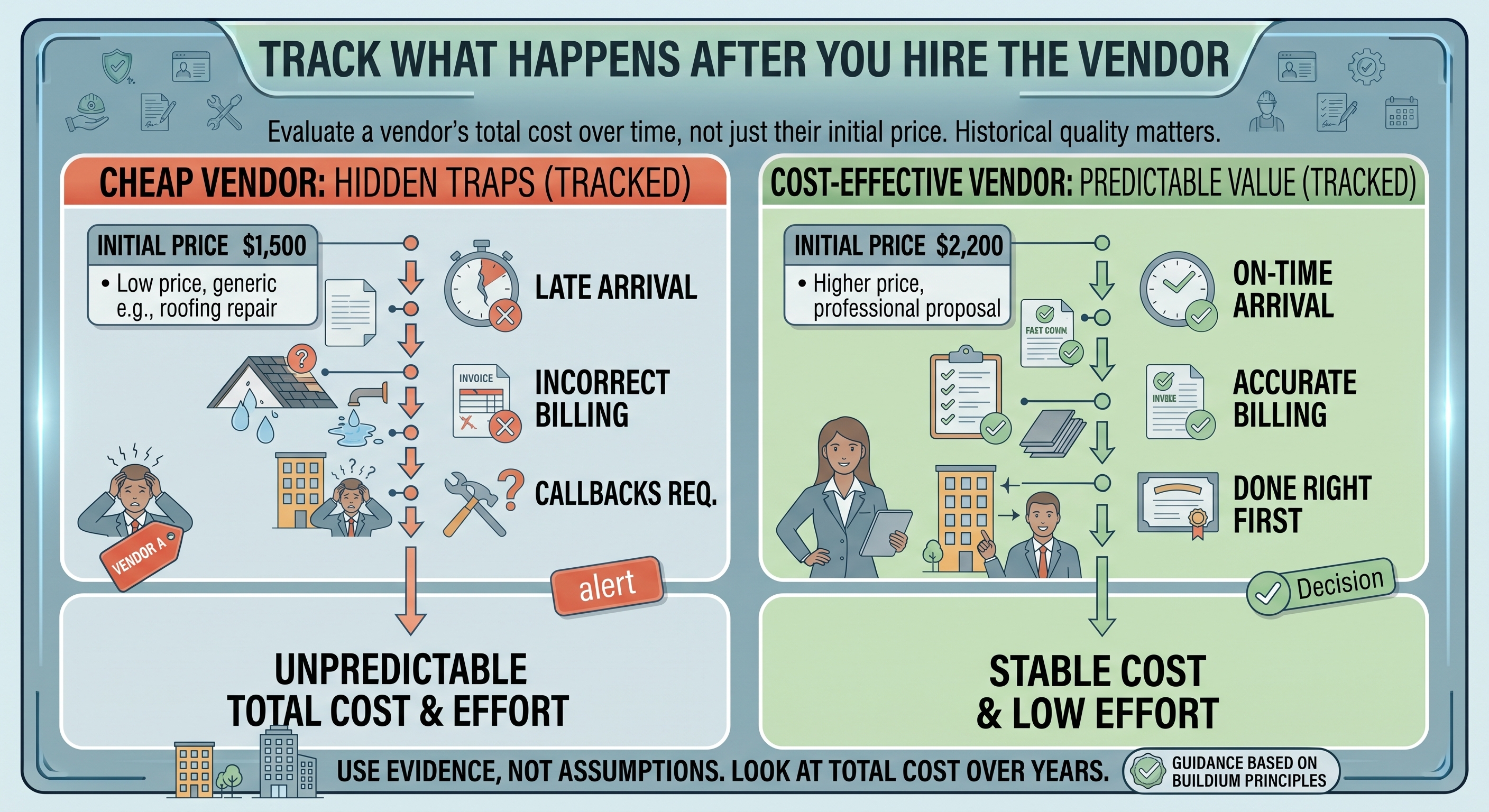
The best way to determine whether a vendor is cost-effective is to stop relying entirely on assumptions.
Track performance.
After several projects, a property manager can begin answering questions such as:
Did the vendor consistently arrive when scheduled?
How often did the final invoice exceed the proposal?
How frequently were callbacks necessary?
Did work meet the expected standard?
How quickly did the vendor respond when there was a problem?
Were invoices accurate?
Did the vendor provide required documentation?
Were tenants or building staff satisfied with the process?
Did the relationship require an unusual amount of management time?
Buildium's property-management vendor guide recommends maintaining vendor records and tracking work orders so managers can evaluate costs, completion times, response times, and work quality over time.
This changes vendor selection from a subjective decision into a more evidence-based process.
A company may look expensive during the first bidding process but prove extremely cost-effective over three years.
Another may initially appear inexpensive but gradually become one of the property's most demanding vendors.
Historical performance provides information that a proposal cannot.
The Goal Is Not to Avoid Cheap Vendors
There is nothing inherently wrong with hiring the cheapest vendor.
Sometimes the lowest bidder really is the best choice.
A well-run company may have lower overhead, better equipment, more efficient processes, better routing, greater purchasing power, or simply a business model that allows it to provide the same result for less money.
Property managers should want those efficiencies.
The problem occurs when cheap becomes the entire selection strategy.
A vendor that costs less but requires more supervision, produces inconsistent work, creates repeated change orders, misses scheduled work, or introduces unnecessary risk may ultimately cost the property more.
Conversely, paying more without receiving additional value is not good property management either.
The objective is to find the point where price, performance, reliability, scope, and risk make sense together.
That is what separates a cheap vendor from a cost-effective vendor.
And for a property manager responsible for protecting both a building and its operating budget, understanding that difference can be considerably more valuable than simply finding the lowest number on a proposal.
About the Author
Tre Williams is the Content Manager at Squeegee Squad Tulsa. He creates educational content focused on commercial property maintenance, window cleaning, vendor transparency, and the questions property managers and building owners should consider when evaluating service providers.
Tags
Property Management, Vendor Management, Cost-Effective Vendors, Choosing a Vendor, Commercial Property Management, Vendor Selection, Property Maintenance, Facility Management, Contractor Selection, Vendor Pricing, Commercial Maintenance, Building Maintenance, Property Manager Guide, Vendor Risk Management