
 By
By
Key Takeaways
- Square footage alone does not tell you how difficult a building will be to clean. Access, glass condition, building design, landscaping, and environmental exposure can dramatically change the scope of work.
- Last year's window cleaning invoice is not automatically a reliable starting point for next year's budget.Conditions around a property can change even when the building itself does not.
- Access can be one of the biggest variables in commercial window cleaning. A window that requires specialized equipment, fall protection, or rope access is fundamentally different from glass accessible from the ground.
The Number on Your Window Cleaning Proposal Doesn't Tell the Whole Story
Budgeting for commercial window cleaning sounds like it should be simple.
Determine how much glass the property has, look at what you paid last year, account for inflation, and put a number into next year's operating budget.
But there is a problem.
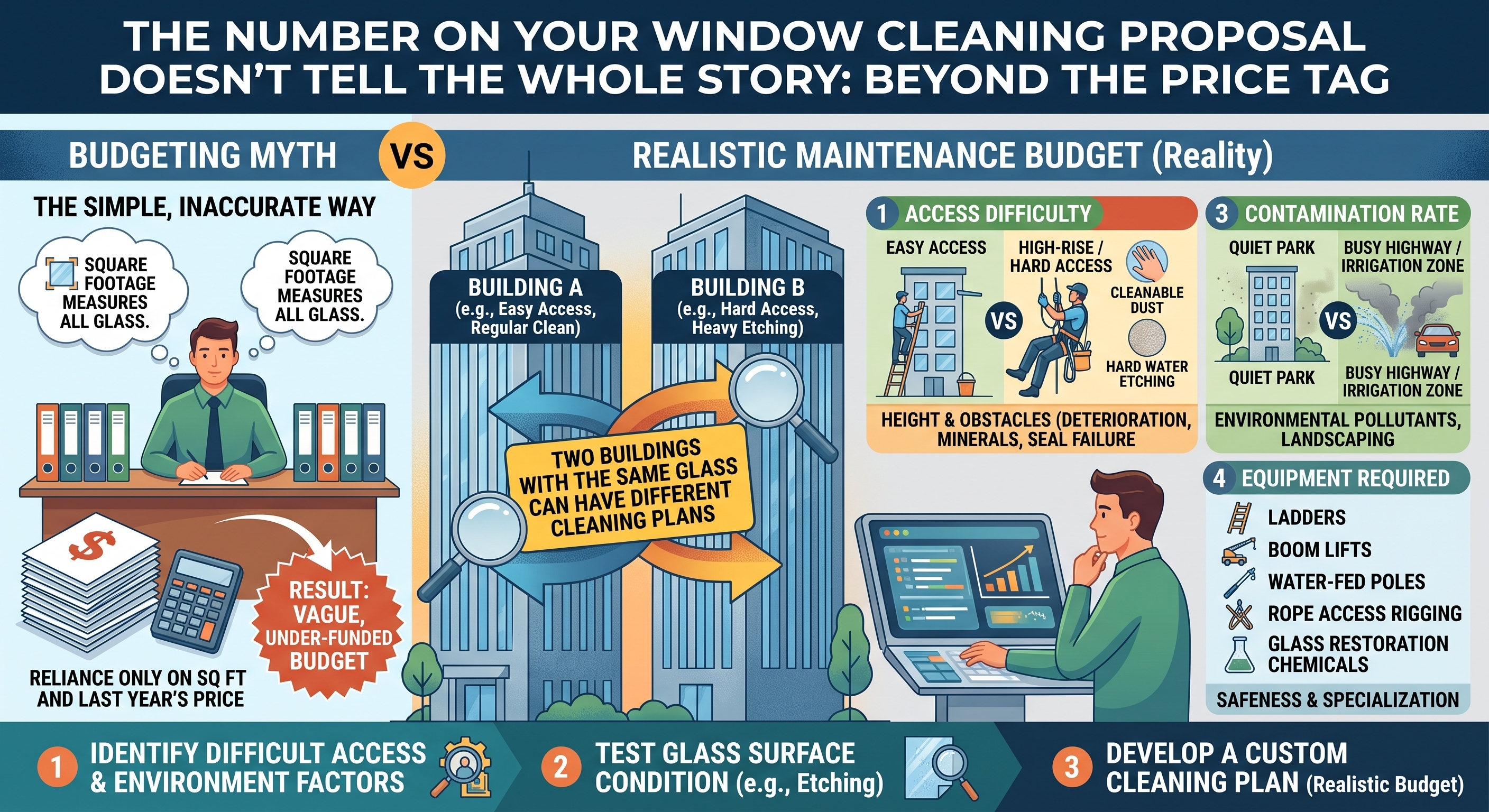
Two buildings with approximately the same amount of glass can require completely different cleaning plans.
Square footage measures the amount of glass.
It does not necessarily measure the difficulty of reaching it, the condition of the surface, how quickly it becomes contaminated, or the equipment required to safely perform the work.
That distinction matters when property managers are trying to create realistic exterior maintenance budgets.
Access Can Change the Entire Job
Imagine two office buildings with 20,000 square feet of exterior glass.
Building A has large sections of glass that can be reached using water-fed poles from relatively open areas surrounding the property.
Building B has architectural setbacks, landscaping, roof sections, restricted areas, and elevated glass requiring specialized access.
On paper, both properties may have roughly the same amount of glass.
Operationally, they are completely different jobs.
This becomes even more significant when rope descent systems are required.
The Occupational Safety and Health Administration's rope descent system requirements establish specific requirements involving anchorages, training, inspections, independent fall-arrest systems, rigging, rescue provisions, and other safety measures.
OSHA also requires building owners to provide written information confirming that applicable rope-descent anchorages have been identified, tested, certified, and maintained before those systems are used.
That means access is not simply a matter of how high a window happens to be.
Access can determine the equipment, planning, documentation, labor, and safety procedures required to clean it.
Glass Condition Matters Too
Another problem with budgeting strictly from square footage is that square footage does not describe the condition of the glass.
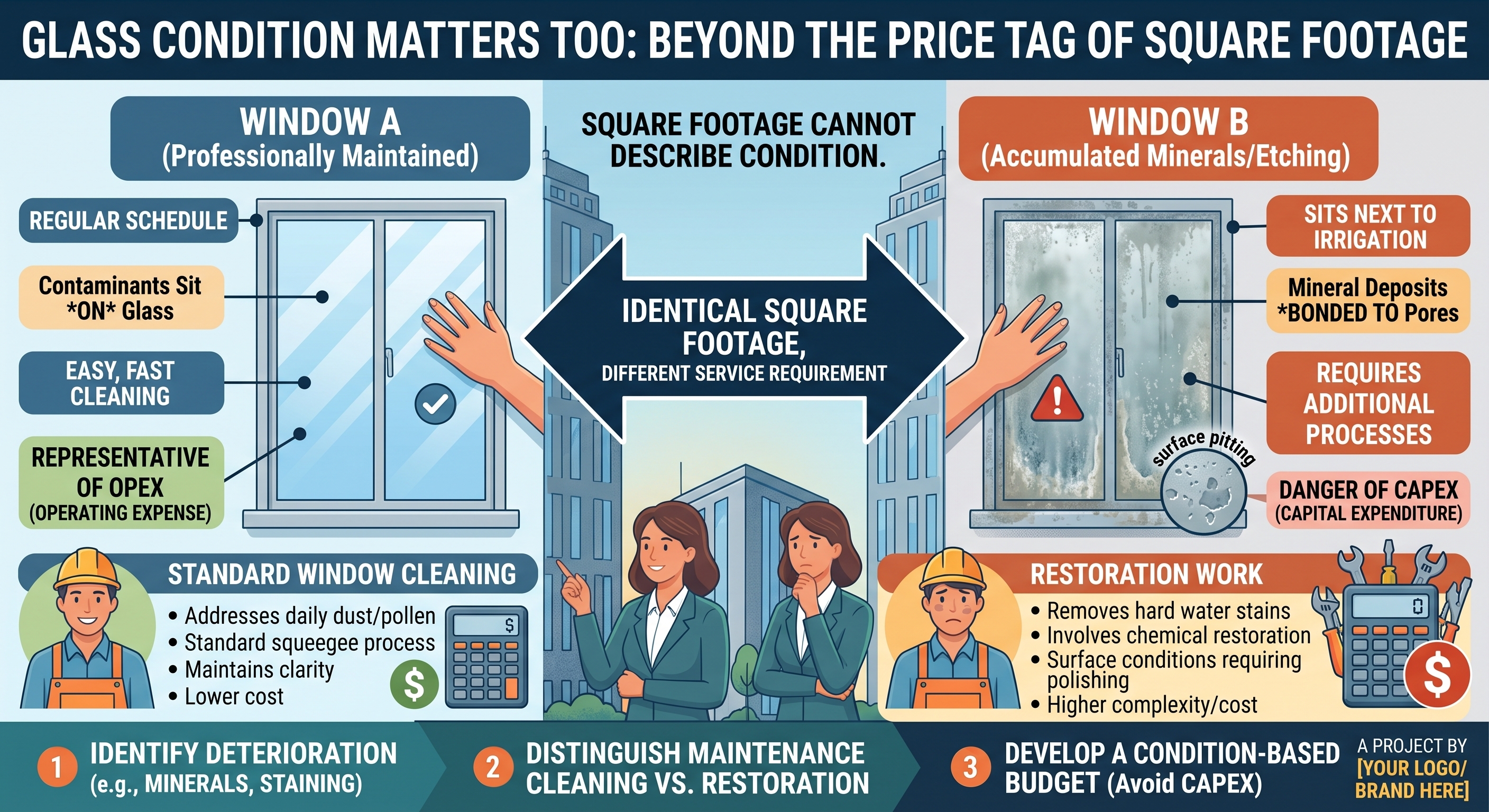
Consider two identical windows.
One has been professionally maintained on a regular schedule.
The other sits next to irrigation and has accumulated mineral deposits over an extended period.
Those windows may have identical dimensions, but they may not require identical work.
This is one reason property managers should distinguish between maintenance cleaning and restoration work.
Standard window cleaning primarily addresses contaminants sitting on the glass.
Restoration can involve deposits, staining, or surface conditions that require additional processes.
Waiting longer between services therefore does not automatically mean that the next cleaning will simply cost the same amount as the previous cleaning.
Your Property Can Change Without the Building Changing
A building does not have to undergo a renovation for its window cleaning requirements to change.
Think about what can happen around a commercial property over several years:
New landscaping is installed.
Irrigation patterns change.
A neighboring development begins construction.
Trees mature.
Parking patterns change.
Traffic increases.
New signage or awnings create access obstacles.
Building modifications change how certain areas can be reached.
Suddenly, the assumptions behind a cleaning proposal created several years ago may no longer reflect the property.
This is why automatically carrying last year's window cleaning number into next year's budget can create problems.
You may be budgeting for the building you used to manage instead of the conditions you actually have today.
Safety Is Part of the Scope
Safety requirements also demonstrate why commercial window cleaning cannot always be reduced to a price-per-window calculation.
OSHA's rules for rope descent systems require employers to address issues including training, equipment inspections, proper rigging, independent personal fall arrest systems, rescue, rope protection, and hazardous weather.
Those requirements exist regardless of whether the customer ever sees the preparation taking place.
That is an important distinction when comparing commercial window cleaning proposals.
A lower number does not necessarily mean that one contractor discovered a dramatically more efficient way to clean the same building.
The first question should be:
Are these contractors actually quoting the same scope of work?
A Better Way to Build the Budget
Instead of asking only, "What did window cleaning cost last year?" property managers should review the conditions driving that cost.
Consider:
- Which elevations become dirty fastest?
- Which windows are affected by irrigation?
- Has construction occurred nearby?
- Which areas require specialized access?
- Have landscaping conditions changed?
- Are all elevations being cleaned at the correct frequency?
- Is restoration beginning to become necessary anywhere?
- Have access or safety requirements changed?
This produces a budget tied to the actual property rather than an arbitrary historical number.
It can also reveal opportunities to spend money more intelligently.
Some elevations may require additional attention.
Others may not.
The Goal Isn't Necessarily to Spend More
This is the most important part.
A better window cleaning budget does not automatically mean a bigger window cleaning budget.
Sometimes the answer is increasing service in a problem area.
Sometimes it is reducing unnecessary service somewhere else.
Sometimes it is fixing an irrigation problem.
Sometimes it is addressing glass deterioration before restoration becomes more extensive.
The objective is understanding why you are spending the money in the first place.
Because if your entire exterior glass budget is based on square footage and last year's invoice, you may be budgeting around the easiest numbers to measure rather than the conditions actually affecting your building.
About the Author
Treshaun Williams is the Content Manager at Squeegee Squad Tulsa, where he creates educational content focused on commercial window cleaning, property maintenance, safety, and the issues property managers should understand before selecting an exterior maintenance provider. His work combines industry research with real-world insight from Squeegee Squad Tulsa's commercial window cleaning operations.
Tags
Commercial Window Cleaning, Property Management, Property Manager, Building Maintenance, Window Cleaning Budget, Facility Management, Commercial Property Maintenance, Tulsa Window Cleaning, Squeegee Squad Tulsa