 By
By
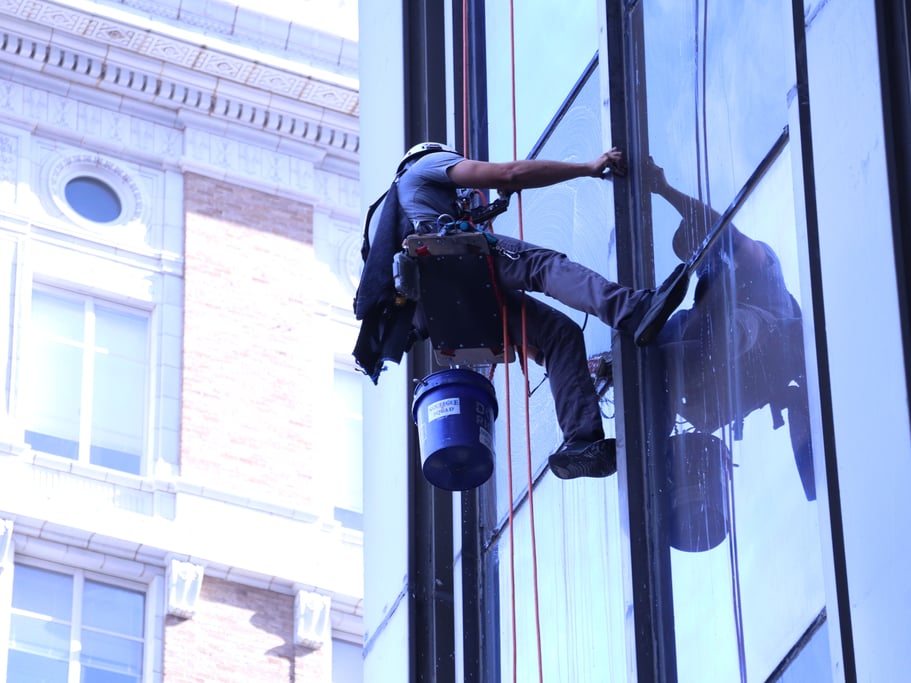
Most property managers treat high-rise window cleaning like any other line item on the maintenance calendar pick a quarter, book the vendor, move on.
We hear it on almost every scheduling call: “Just put us in for March” or “let's do the summer slot, that's when everyone else does it.” Property management software often defaults renewal dates to the same week every six months, with no one checking whether that week is actually a good one to be on the glass.
After over ten years running high-rise crews across the Tulsa metro area, we've learned that two stretches on the Oklahoma calendar quietly cause more delays, safety pull-offs, and rescheduling than every other month combined.
This article breaks down which months those are, what Oklahoma's own weather data says about why, and how to build a schedule that works with the state's climate instead of against it.
Key Points:
- March and April are Oklahoma's windiest months on record, and in our decade of high-rise work across northeastern Oklahoma, wind and heat illness are consistently the top two causes of schedule delays.
- July and August combine near-record heat with high humidity, creating heat-illness risk that regularly pulls crews off suspended equipment mid-shift.
- Industry wind-safety guidance (ANSI/IWCA I-14.1) calls for stopping suspended access work at sustained winds above 25 mph, the same threshold our own employee manual, Squad Code, sets as a hard stop.
- Even with disciplined scheduling, our crews still see roughly 10–15 delayed days a year tied to wind or heat, but fewer than 5 full call-offs.
- South- and west-facing glass takes the worst of it in summer; direct sun and glass reflection create real sunburn and heat-exposure risk for crews, not just discomfort.
- Winter, not spring or summer, is consistently the most productive and safest season for high-rise window cleaning in Oklahoma.
“High-rise” here means any job requiring suspended access equipment or rope descent systems swing stages, boatswain's chairs, or rope access as distinct from ladder, water-fed pole or drone work on shorter buildings.
What Do Most Property Managers Think About Scheduling High-Rise Window Cleaning?
Most property managers treat scheduling as a formality pick a quarter, pick a vendor, move on.
We're not going to pretend that approach never works. For a lot of low-rise or ground-level jobs, timing genuinely doesn't matter much.
The real question isn't whether timing matters at all, it's whether property managers are choosing their schedule on purpose or by default, and what that default is quietly costing them in rescheduled visits, rushed crews, and inconsistent results.
Are the Stereotypes About High-Rise Scheduling Actually True?
Some frustration with delayed or rescheduled cleanings comes from real bad experiences. Most of it actually traces back to scheduling during Oklahoma's two worst months, not the service itself.
Remember the May 19, 2019 window cleaning incident at Devon Tower in Oklahoma City? The building maintenance unit (BMU) was caught in high winds with two workers in it, and swung out of control for some time, causing significant damage to Devon Tower. Court records show that workers of Budget Glass Cleaning, Inc., the defendant in the case, were working on the building when documented wind speeds were around 38 miles per hour. While these cases are rare in Oklahoma, choosing to clean the Devon Tower windows during one of the windiest months of the year, was a failure on the part of both contractor and hiring client.
When a crew has to abort a high-rise job because sustained winds cross 25 mph, or get off a lift at 1 p.m. because heat conditions have moved into dangerous territory, property managers tend to see it as a vendor problem. In most cases it's a calendar problem, the job was booked in the one window most likely to cause it.
A canceled or rescheduled cleaning day gets a call to the property manager and gets remembered for years. Every quietly successful December or January cleaning, finished on time and under budget, never comes up in conversation at all.
What the Research Actually Says:
Oklahoma's own climate data backs up what a decade on ropes has taught us.
According to the Oklahoma Climatological Survey at the University of Oklahoma, March and April are consistently the state's windiest months, while July, August, and September are its calmest. The Oklahoma Mesonet has recorded April as the windiest calendar month in its climatological record.
Separate National Weather Service data for Tulsa shows July as the city's hottest month, with average highs near 93°F — and heat index values that regularly climb well past that once the region's summer humidity is factored in.
Oklahoma High-Rise Window Cleaning: Wind & Heat Data Table
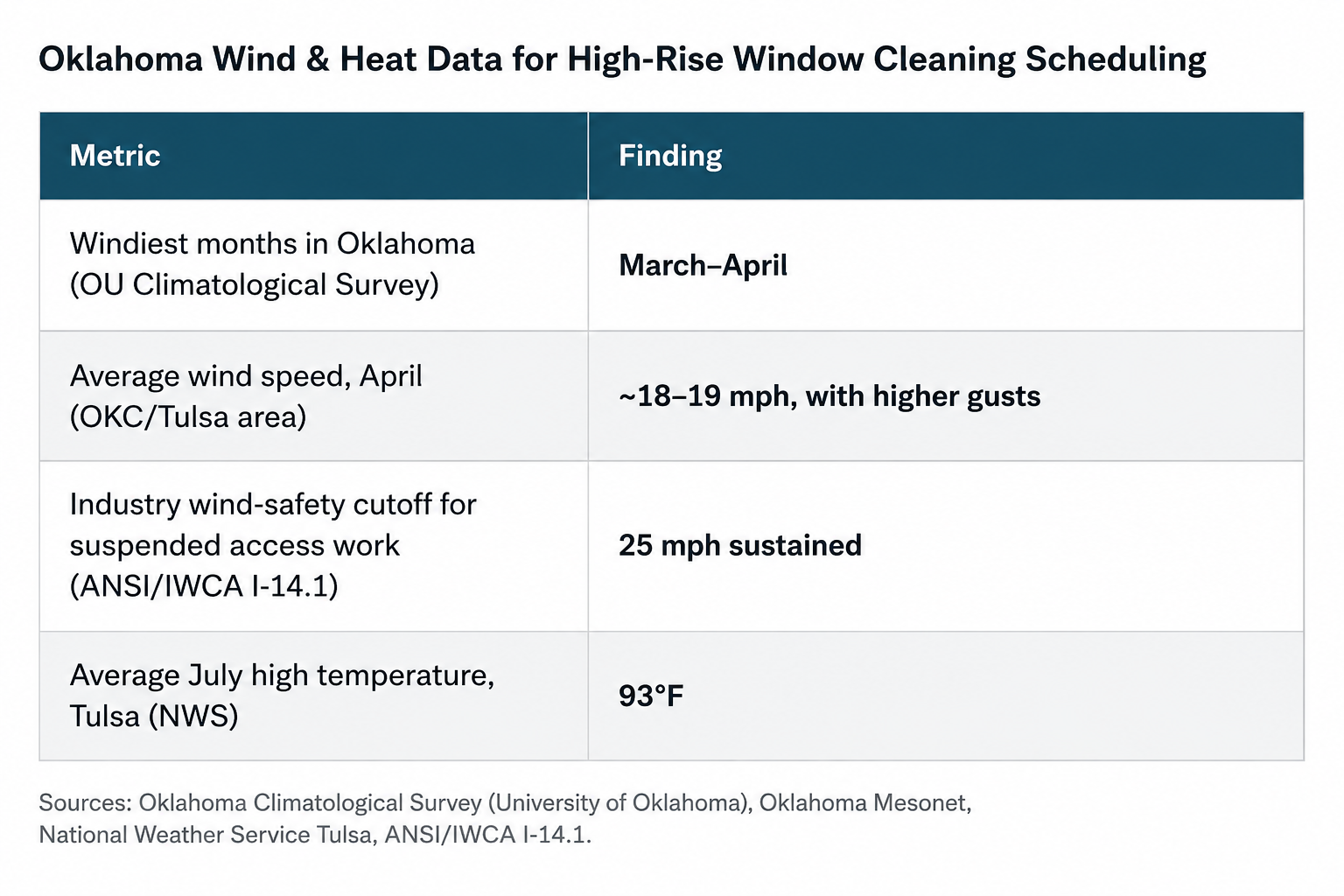
The two months property managers most often default to for “spring cleanup” and “summer refresh” are, climatologically, the two worst months in Oklahoma to have a crew on ropes.
That lines up with exactly what we track internally every season.
What We've Seen on Our Own Crews
Jobs scheduled around Oklahoma's wind and heat patterns simply run smoother than ones booked by default.
Wind pulls a high-rise crew off a building before they even drop their ropes. Heat delays a lift after only 4-5 hours of use. A rescheduled day costs a property its place in that week's lineup, not just a day.
That pattern shows up on nearly every high-rise account we've run for more than a few seasons, and it's exactly why we built our own scheduling rules around it.
During the windiest stretch of spring, our crews work the non-windy side of the building first and track live wind conditions throughout the day, watching for sustained breaks before moving equipment back to the exposed side. Our employee manual, Squad Code, sets a hard stop at sustained wind over 25 mph — no exceptions, no judgment calls in the moment. That single rule, applied consistently, is often the difference between finishing a job on schedule and losing a day entirely.
On the hottest jobs of summer — particularly buildings with heavy south- or west-facing glass — the difference between sides of the same building can be dramatic. A north face stays workable most of the day because it gets no direct sun in the northern hemisphere. A south face in July can reflect enough direct sunlight to sunburn a crew within a couple of hours. On those jobs, we maximize productivity on cloudy days and start as early as 6 a.m. to get ahead of both the heat and the sun angle.
Those results aren't luck. They come from working around Oklahoma's calendar, not against it.
The 5 Factors That Predict Whether a High-Rise Job Gets Delayed
Whether a scheduled high-rise cleaning day gets delayed comes down to five things, not luck.
- Season: whether the job falls in March–April or July–August versus the calmer, cooler months.
- Building orientation: how much south- and west-facing glass the property has, since that side takes the worst sun and heat exposure.
- Height and exposure: taller, more exposed buildings catch more wind at altitude than surrounding structures shield them from.
- Start time: whether the crew begins as early as 6 a.m. to get ahead of both wind buildup and peak heat.
- Monitoring discipline: whether the crew is actively tracking real-time wind conditions for sustained breaks, not just checking a morning forecast.
Score a scheduled job against those five, and you can predict, with real accuracy, whether it's headed for a delay before the crew ever shows up.
What Property Managers Need to Have in Place
Getting a high-rise cleaning finished on schedule and safely depends on conditions in place before a crew is ever booked.
A flexible scheduling window, not a fixed date: building in a few flex days around a booked date so a wind or heat delay doesn't cascade into a missed cleaning altogether.
A vendor with documented, written weather thresholds: our own employee manual, Squad Code, defines extreme wind as sustained speeds over 25 mph and extreme cold as a high that stays below 25°F all day, both hard stops, not judgment calls made on site.
A preference for the off-season: booking cool-weather months (October–May) when crews can safely work longer days, rather than defaulting to spring or summer out of habit.
Schedule flexibility, vendor protocol, and season choice work together missing any one of them is usually why a “we'll just do it in spring” job turns into three reschedules.
The Real Cost of Scheduling During Oklahoma's Worst Months
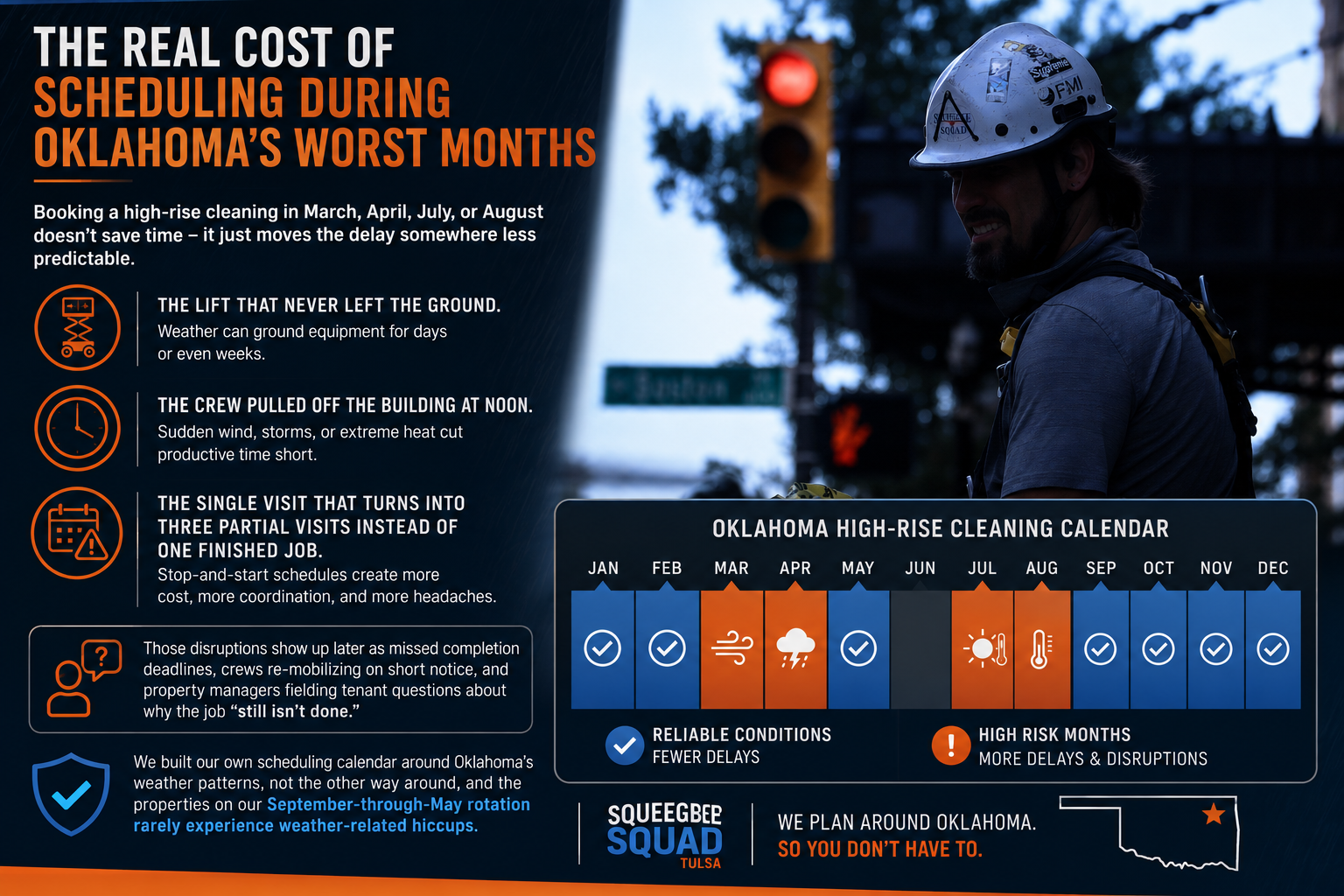
Booking a high-rise cleaning in March, April, July, or August doesn't save time it just moves the delay somewhere less predictable.
The lift that never left the ground. The crew pulled off the building at noon. The single visit that turns into three partial visits instead of one finished job.
Those disruptions show up later as missed completion deadlines, crews re-mobilizing on short notice, and property managers fielding tenant questions about why the job “still isn't done.”
We built our own scheduling calendar around Oklahoma's weather patterns, not the other way around, and the properties on our September-through-May rotation rarely experience weather-related hiccups.
When Is the Best Time to Clean High-Rise Windows in Oklahoma?
Contrary to popular belief, winter is one of the best times to clean high-rise windows in Oklahoma.
Our Tulsa-based crews actually prefer cool weather over hot weather, so we fill our schedule from September through May as much as we can. That's partly personal preference, we like to keep our employees happy, so we tend to stack our schedule during the cooler months and lighten it during the hottest stretch of summer.
Buildings also get their most direct southern sun exposure during the winter, so the results tend to show especially well right after a winter cleaning. Average Oklahoma winter temperatures make the work comfortable rather than miserable. Our crews wear multiple layers and stay active on the glass, so cleaning windows in winter ends up feeling a lot like jogging in winter, once your body heats up, you stop noticing the cooler air.
The one winter exception is genuinely extreme cold. Squad Code, our employee manual, also sets a hard stop when the day's high never climbs above 25°F. Those days are rare in northeastern Oklahoma and easy to plan around, which is a big part of why our September-through-May calendar still ends up far more predictable than a spring or summer one.
When Should You Really Schedule High-Rise Window Cleaning? Our Honest Answer
We could have taken the easy path booking whatever quarter fit each property's default maintenance calendar, the way most vendors do.
Instead, we built our own high-rise schedule around Oklahoma's wind and heat data, stacking cooler months and lightening the calendar during the state's two worst stretches.
That's the schedule we now recommend to every high-rise client we work with in northeastern Oklahoma.
The question isn't whether high-rise window cleaning is worth scheduling. It's whether your property's current schedule was chosen on purpose, or just inherited from last year's calendar.
If you manage a high-rise property in the Tulsa or Washington County area and aren't sure your cleaning schedule is working with Oklahoma's weather instead of against it, we'd welcome a walk-through.
How to Take Action Now
- Check your current cleaning schedule against March–April and July–August, and flag any bookings that fall inside those windows.
- Ask your current vendor what wind speed and heat conditions trigger a delay, and how they monitor for it in real time.
- Build a few flex days into any spring or summer booking so a weather delay doesn't turn into a missed cleaning.
- Consider shifting your annual schedule toward October–May, when Oklahoma's weather works in your favor instead of against it.
Related Article: “What Happens If A Window Cleaner Gets Hurt On your Commercial Property"
Check out our "About Us Page"
About the Author
Melissa Brinkley is a co-owner of Squeegee Squad Tulsa, a commercial window cleaning company serving Tulsa and Washington County, Oklahoma. After a decade of high-rise work across northeastern Oklahoma, the crew builds every schedule around the state's own weather patterns rather than the calendar default.
Frequently Asked Questions
What time of year should high-rise window cleaning be avoided in Oklahoma?
March and April, because of sustained high winds, and July and August, because of extreme heat and humidity, cause the most scheduling delays for high-rise work in Oklahoma.
What wind speed stops high-rise window cleaning?
Most professional crews use a sustained wind threshold around 25 mph, based on industry guidance like ANSI/IWCA I-14.1. Our own employee manual, Squad Code, sets that same 25 mph sustained threshold as a hard stop for suspended access work.
Is winter actually a good time to clean high-rise windows in Oklahoma?
Yes. Oklahoma winters are mild enough for active outdoor work, buildings get more direct southern sun exposure, and wind and heat delays are far less common than in spring or summer.
How many days a year get delayed for wind or heat in Oklahoma?
In our experience running high-rise crews across northeastern Oklahoma, roughly 10–15 days a year get delayed for wind or heat, with fewer than 5 days fully called off.
What's the difference between a delayed day and a canceled day for high-rise cleaning?
A delayed day still gets completed, just later in the day. A canceled day is called off entirely and has to be rescheduled.
Sources & References
- Oklahoma Climatological Survey, University of Oklahoma - “Oklahoma Climate”: ou.edu/ocs/oklahoma-climate
- Oklahoma Mesonet - “April Winds Highest in Mesonet Era”: climate.mesonet.org
- National Weather Service, Tulsa Climate Summary: weather.gov/tsa
- ANSI/IWCA I-14.1, Window Cleaning Safety Standard (industry wind-speed threshold for suspended access work)
- OSHA, 29 CFR 1926.451(f)(12) - Scaffold use in windy conditions
- OSHA, Heat Illness Prevention guidance: osha.gov/heat-exposure
- Squad Code, Squeegee Squad Tulsa employee manual (internal wind and cold-weather safety thresholds)
Tags: High-Rise Window Cleaning, Commercial Window Cleaning, Tulsa Window Cleaning, Oklahoma Window Cleaning, High-Rise Building Maintenance, Commercial Building Maintenance, Window Cleaning Scheduling, Oklahoma Weather, Property Management, Facility Management, Preventative Maintenance, Exterior Building Maintenance, Commercial Property Maintenance