
 By
By

Budget season has a way of turning every line item into a target. When you're staring down a spreadsheet trying to shave costs before it goes to ownership or the board, exterior maintenance is usually one of the first things someone suggests trimming. It's not code required. It's not tied to a life safety system. Nobody's going to get hurt if the windows go from quarterly to twice a year.
That's exactly why it's the easiest cut to justify and one of the most expensive ones to actually make.
We work with property managers across the Tulsa metro every budget cycle, and we've watched the same pattern play out enough times to see where it goes. A 10% reduction to an exterior maintenance line looks harmless in year one. By year three, it's not a savings anymore. It's a bill, and usually a bigger one than the cut ever produced.
Why Exterior Maintenance Is Usually the First Thing Cut
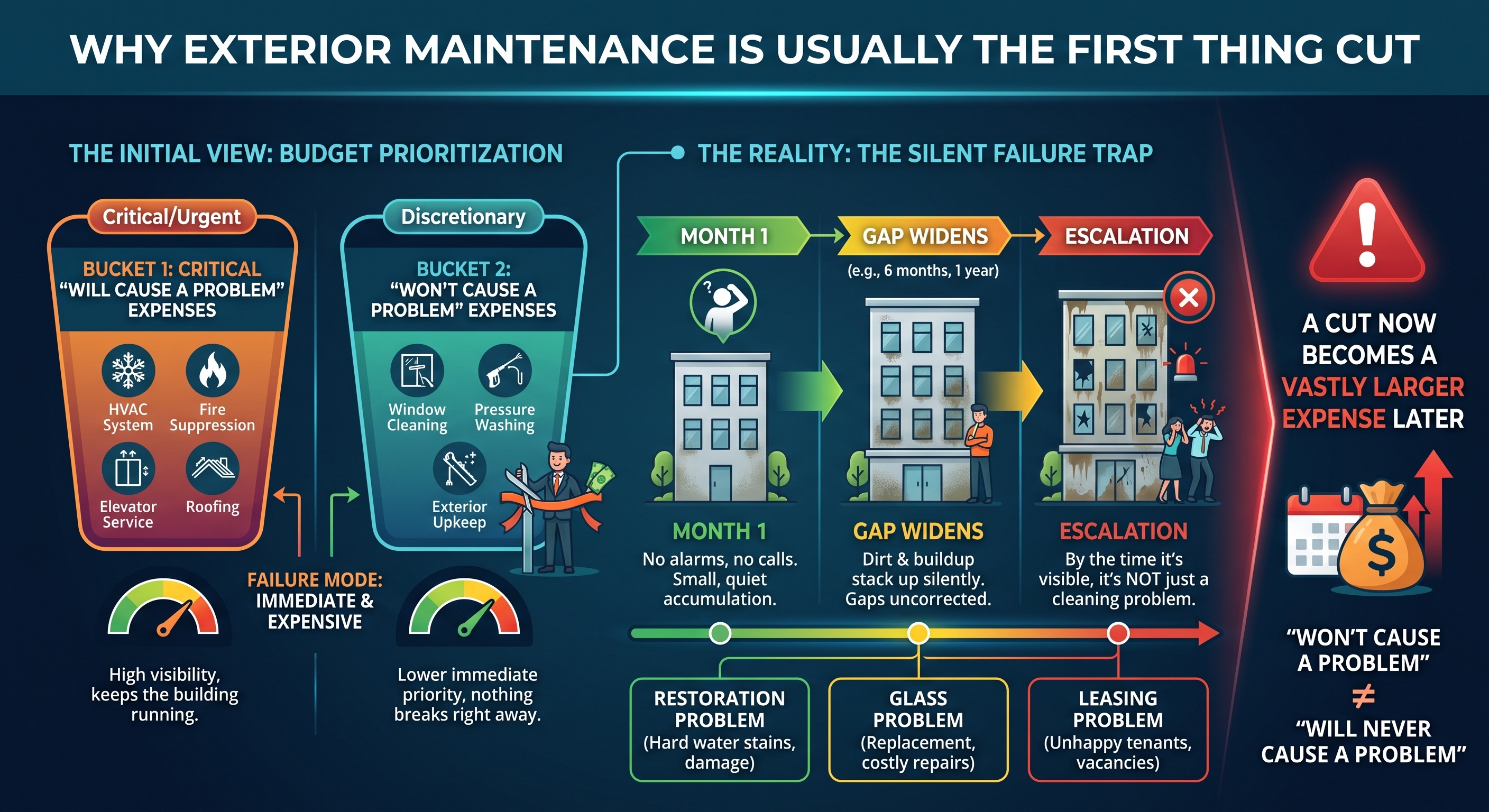
Most operating budgets separate expenses into two buckets, whether anyone says it out loud or not: things that will cause a problem if you don't pay for them, and things that won't. HVAC, fire suppression, elevator service, and roofing tend to land in the first bucket because the failure mode is immediate and expensive. Window cleaning, pressure washing, and general exterior upkeep almost always land in the second, because nothing breaks the week after you skip a cleaning.
That framing is exactly where property managers get it wrong, because "won't cause a problem" and "will never cause a problem" are not the same thing. Window cleaning belongs to a category of maintenance that fails quietly. Nothing breaks, no alarm goes off, and nobody gets a call in month one. The building simply accumulates a little more buildup than it would on a normal schedule, and that gap keeps widening with every cycle left uncorrected instead of resetting to zero. By the time it's visible enough to register as an actual problem, it usually isn't a cleaning problem anymore. It's a restoration problem, a glass problem, or a leasing problem, and all three cost more than staying on schedule would have. A cut to the "won't cause a problem" bucket has a way of becoming a very real problem, it just takes longer to show up than a budget season is built to notice.
What a 10% Cut Actually Looks Like on a Property
Say a mid-size Tulsa office building budgets around $18,000 a year for exterior glass and building maintenance. A 10% cut sounds small, maybe $1,800 saved. In practice, that number doesn't come out of a single invoice. It comes out of frequency and scope.
That usually means one of a few things happens:
- Quarterly cleanings drop to twice a year
- Interior glass gets skipped and only the exterior gets touched
- Screens, tracks, and sills come off the scope entirely
- The building switches to whichever vendor quoted the lowest number, without asking what that number does and doesn't include
None of these show up as a problem on day one. That's the whole reason the cut felt safe to make.
The cut usually gets justified with a comparison, too. Someone pulls a quote from a competitor charging less, or points to a similar building down the road that spends less on the same line item, and the number gets treated as proof the current budget has room to shrink. What that comparison almost never accounts for is scope. A lower number attached to fewer visits, less coverage, or a crew that isn't insured the way yours is isn't a cheaper version of the same service. It's a different service that happens to share a line item name.
Year One: Nobody Notices
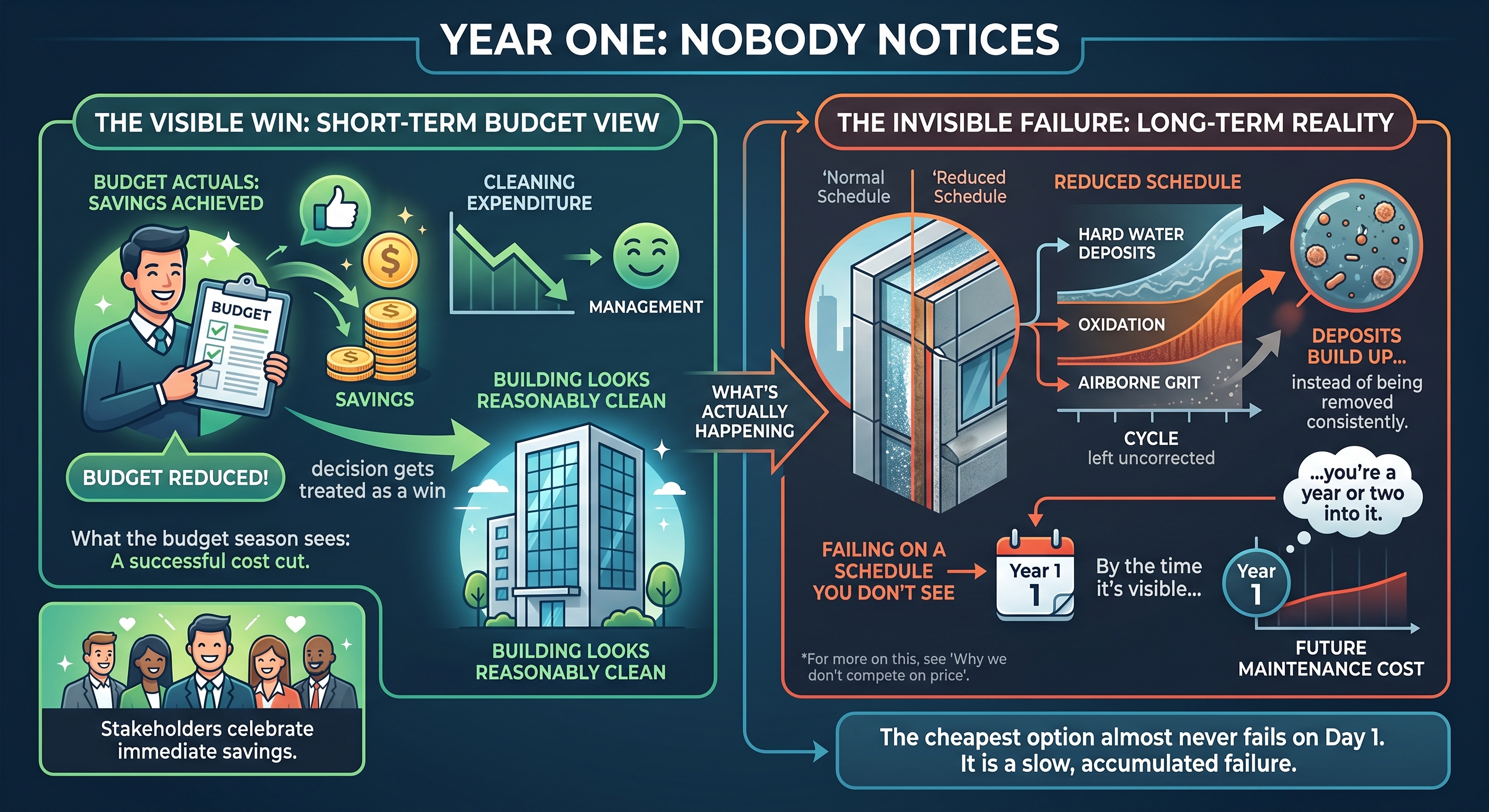
This is the part budget season doesn't account for. In year one, a reduced cleaning schedule looks like it worked. The building still looks reasonably clean, the savings show up in the actuals, and the decision gets treated as a win.
What's actually happening is that hard water deposits, oxidation, and airborne grit are building up a little more between each visit instead of getting removed on a consistent cycle. We wrote about this in more detail in why we don't compete on price, but the short version is that the cheapest option almost never fails on day one. It fails on a schedule you don't see until you're a year or two into it.
Year Two: The Math Starts Working Against You
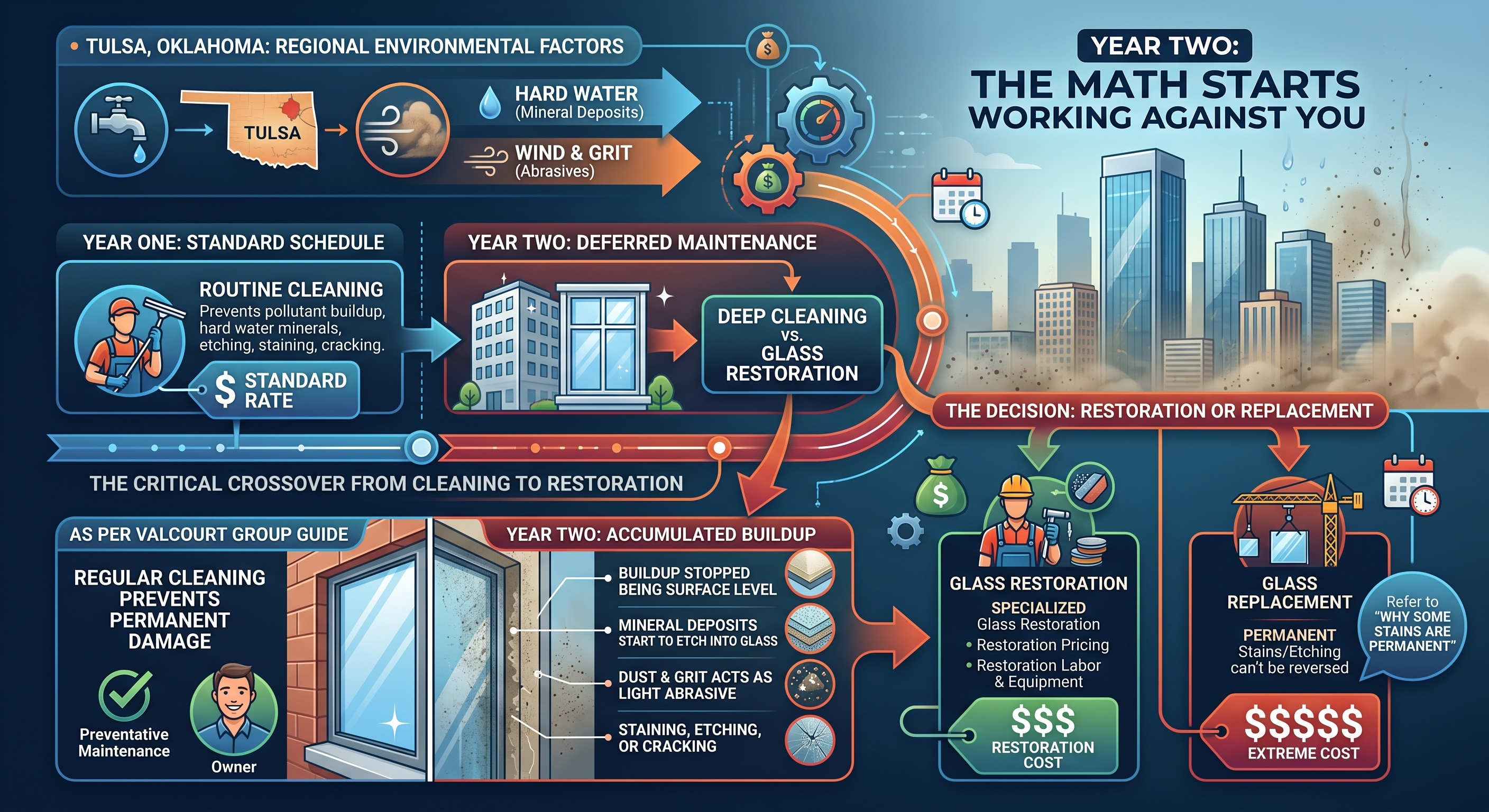
By year two, the buildup from the reduced schedule has stopped being surface level. Mineral deposits from Tulsa's hard water don't just sit on top of the glass, they start to etch into it if they're left long enough between cleanings. Oklahoma's wind doesn't help either. It keeps a steady supply of dust and grit moving across every exterior surface in the metro, and that grit acts like a light abrasive every time it's left to sit rather than get washed off on schedule.
This is exactly the line that separates routine cleaning from glass restoration in the professional window cleaning world. As Valcourt Group's guide to the difference between deep cleaning and glass restoration lays out, regular cleaning on a consistent schedule prevents the buildup of pollutants and hard water minerals that eventually cause staining, etching, or cracking. Once buildup and deferred maintenance push a building past what standard cleaning can restore, the job shifts into specialized glass restoration, at restoration pricing, with restoration labor and equipment. A cleaning that would have cost a standard rate in year one becomes a restoration job in year two.
We also cover this from the other direction in why some stains are permanent. Some mineral etching and glass damage genuinely cannot be reversed once it sets in. At that point, the choice isn't between a cheap cleaning and an expensive one. It's between an expensive cleaning and glass replacement.
Year Three: The Bill Comes Due, and So Does the Vacancy Problem
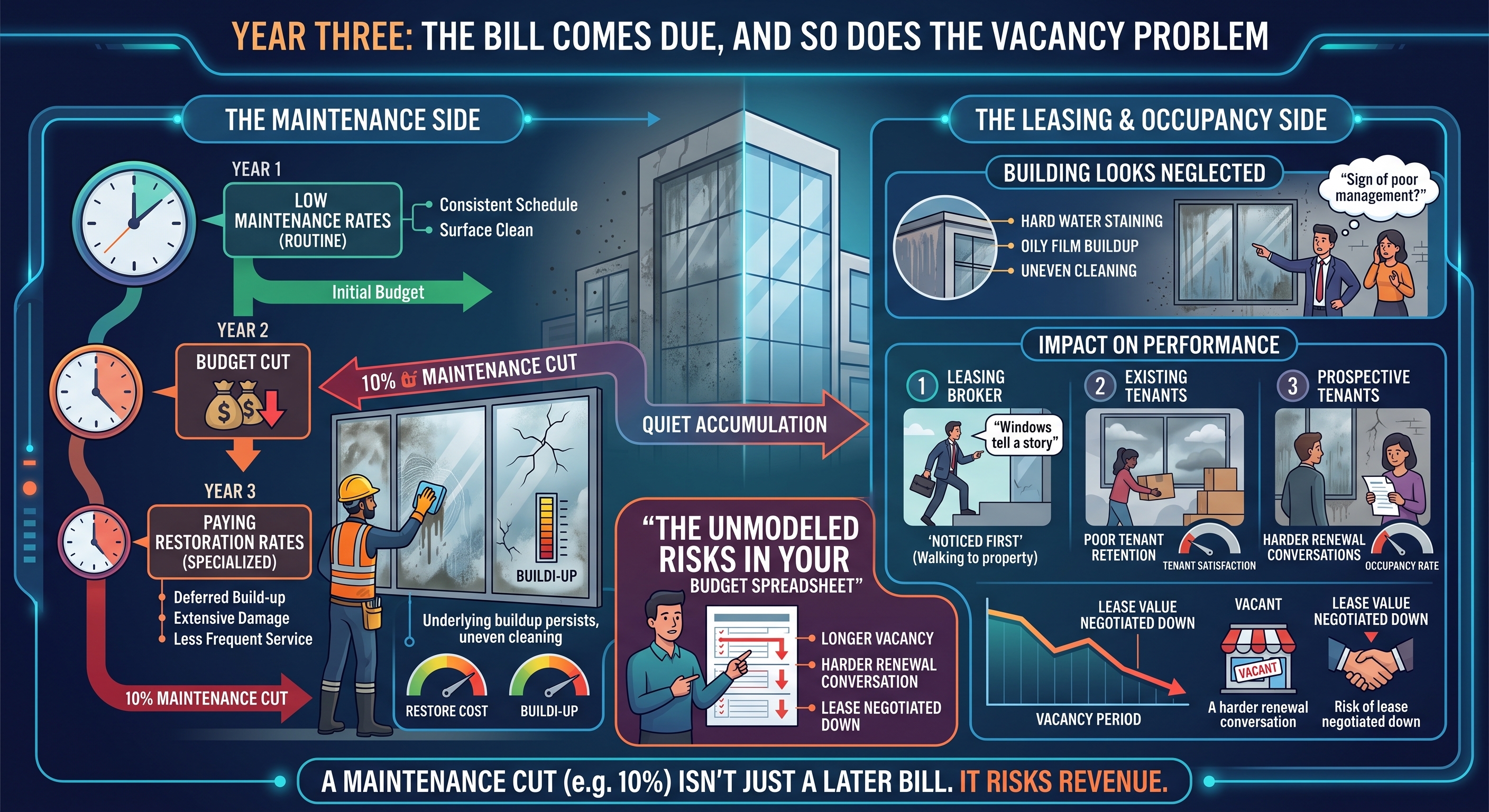
Year three is usually when the cut shows up in two places at once: the maintenance line and the leasing numbers.
On the maintenance side, the building is now paying restoration rates instead of maintenance rates, on a less frequent schedule that doesn't actually resolve the underlying buildup. On the leasing side, window condition has a measurable effect on how a property performs. A breakdown of the window cleaning issues that make commercial properties look neglected points out that hard water staining, oily film buildup, and uneven cleaning across upper and lower floors are among the fastest ways a building signals poor management to tenants and prospects, and that building appearance directly influences tenant retention and occupancy. Prospective tenants and their brokers notice window condition walking up to a building before they notice almost anything else about it.
That's the part that rarely gets modeled in a budget spreadsheet. A 10% cut to a maintenance line doesn't just risk a bigger maintenance bill later. It risks a longer vacancy, a harder renewal conversation, or a lease that gets negotiated down because the building doesn't present the way it should.
Why the Math Hits Differently Depending on the Building
Not every property in the Tulsa metro feels this on the same timeline, and it's worth budgeting accordingly instead of applying one flat percentage across a whole portfolio.
Downtown high-rises take the wind and dust exposure hardest, simply because there's more glass, more height, and fewer windbreaks between the building and whatever is blowing through the corridor that week. That height is also where a cheaper bid gets riskier in a different way. OSHA's ongoing alliance with the International Window Cleaning Association exists specifically because fall protection and water fed pole work are recognized hazard areas in this trade, and a lower quote on a high-rise is sometimes lower because it's cutting corners on the training and equipment that address those hazards, not just on cleaning frequency. A cut there compounds faster than the same cut would on a single-story retail strip. Retail and storefront properties feel the leasing impact sooner, since foot traffic and visibility are the entire point of the space. A prospective tenant touring a storefront with streaked, dingy glass is picturing their own customers having the same reaction. Multifamily and HOA-managed properties tend to feel it last but hardest, because common area glass often gets deprioritized behind unit-level repairs until it reaches a point where an entire building's windows need restoration at once instead of a rotating maintenance schedule.
If you manage more than one property type, this is worth splitting out in the budget rather than negotiating one number for the whole portfolio. A flat 10% cut applied everywhere will hit some of your buildings by year two and others not until year four, but it will hit all of them eventually.
What Property Managers Should Budget For Instead
None of this means exterior maintenance should be untouchable in every budget conversation. It means it should be evaluated based on what the building actually needs, not treated as a flexible number that moves whenever the total needs to come down.
A few things we'd recommend building into a 2027 budget conversation:
- Base frequency on your actual conditions, not a generic industry average. A building near a busy corridor or exposed to more wind and dust needs more visits than one that isn't, and Tulsa's climate pushes most properties toward the higher end of that range.
- Ask any vendor, including us, exactly what's included in a quoted price. Interior glass and frames are often the first things quietly dropped to hit a lower number.
- Separate routine maintenance cleaning from restoration work in your planning. If a building is already showing mineral buildup or etching, budget for a one-time restoration pass rather than assuming a standard cleaning will fix it.
- Treat the exterior maintenance line as protecting the asset's value and leasing performance, not as a cosmetic expense competing with things that feel more urgent.
Final Thoughts
A 10% cut to an exterior maintenance budget will almost always survive year one. It's year three where the math catches up, usually in the form of a restoration invoice, a stained pane that has to be replaced instead of cleaned, or a vacant suite that took longer to fill than it should have.
If you're building your 2027 budget right now and trying to figure out whether your current scope actually matches what your building needs, we're happy to walk through it with you, no pressure and no generic price over the phone. We'd rather help you budget it correctly than watch you find out the hard way in year three.